What Can Investors Learn From Peter Lynch’s Career? 3 Books to Read
Learn what individual investors can take away from Lynch’s career, from identifying opportunities to understanding businesses

When Wall Street legends are mentioned, names like Warren Buffett and Benjamin Graham usually dominate the conversation. Yet few money managers have ever matched the sheer, sustained performance of Peter Lynch. From 1977 to 1990, Lynch took over the Fidelity Magellan Fund when it held roughly $18 million in assets and grew it into a $14 billion powerhouse. Over those thirteen years, he delivered an astonishing average annual return of 29.2%, consistently beating the S&P 500 index and cementing his status as one of the greatest mutual fund managers in history.
What makes Peter Lynch so compelling for everyday investors is not just his track record, but his core belief that ordinary people hold a massive built-in advantage over Wall Street professionals. While institutional fund managers are bogged down by rigid committees, quarterly pressure, and complex spreadsheets, individual investors can spot winning companies simply by paying attention to the world around them. Whether you are just opening your first brokerage account or refining a long-term portfolio, studying Lynch’s career—and reading his three classic books—offers a practical blueprint for building lasting wealth.
Why Peter Lynch’s Magellan Fund Track Record Still Matters Today

To appreciate the lessons from Peter Lynch’s career, it helps to understand the environment in which he succeeded. The late 1970s and 1980s were far from smooth sailing for the stock market. Investors endured double-digit inflation, soaring interest rates, deep economic recessions, and the historic Black Monday crash of October 1987, when the Dow Jones Industrial Average plunged more than 22% in a single day.
Despite those macro headwinds, Lynch never tried to time the market or predict where interest rates were heading. In fact, he famously joked that if you spend thirteen minutes a year on economics, you have wasted ten minutes. Instead of guessing what the Federal Reserve might do next, Lynch focused relentlessly on individual businesses. He believed that stock prices are not lottery tickets; behind every ticker symbol is a real company making real products and earning real profits. If a business grows its earnings over time, its stock price will eventually follow.
For modern retail investors bombarded by 24-hour financial news, social media hype, and algorithmic trading noise, Lynch’s steady, business-first mindset serves as an essential anchor. His career proves that you do not need insider tips, complex derivatives, or a finance degree to outperform the market. You need patience, curiosity, and a willingness to do basic homework.
Core Investing Lessons From Peter Lynch’s Career for Everyday Investors
Throughout his tenure at Fidelity and in his decades of financial education afterward, Lynch distilled his approach into clear, accessible principles that anyone can apply.
1. Invest in What You Know—Then Do the Homework
Lynch’s most famous catchphrase, “invest in what you know,” is also his most misunderstood. Many beginners mistakenly assume this means buying shares of a company simply because they like its coffee, wear its sneakers, or shop at its stores. Lynch clarified that noticing a popular product or a crowded restaurant is only the starting point—it is a lead, not a buy signal.
Once you spot a promising business in your daily life, you still have to look under the hood. Does the company have manageable debt? Are sales and earnings growing steadily? How much room does it have left to expand across the country? Lynch famously owned stocks like Dunkin’ Donuts, Hanes, and Taco Bell not merely because he liked their products, but because he observed their popularity firsthand and verified that their financial fundamentals and expansion plans were rock-solid.
2. Understand the Six Categories of Stocks
Not all stocks behave the same way, and Lynch emphasized that expecting a slow, mature utility company to triple in value is a recipe for disappointment. Before buying any share, he categorized companies into six distinct buckets so he knew what role each stock played in his portfolio:
- Slow Growers: Large, established companies that grow slightly faster than the overall economy and usually pay reliable, generous dividends.
- Stalwarts: Massive, household-name corporations (such as Coca-Cola or Procter & Gamble) that offer steady 10% to 12% annual earnings growth and provide strong protection during economic downturns.
- Fast Growers: Small, aggressive companies expanding at 20% to 25% per year. While they carry higher risk, this category is where Lynch found his biggest winners.
- Cyclicals: Businesses whose sales and profits rise and fall with the broader economy, such as automakers, airlines, and steel producers. Timing the economic cycle is critical with these stocks.
- Turnarounds: Battered, struggling companies that are restructuring, cutting debt, or recovering from a crisis. When they survive, their stock prices can rebound dramatically.
- Asset Plays: Companies sitting on valuable hidden assets—such as prime real estate, patents, or cash reserves—that Wall Street analysts have overlooked.
3. Hunt for “Tenbaggers” and Embrace Growth at a Reasonable Price (GARP)
Lynch coined the baseball-inspired term “tenbagger” to describe a stock that rises to ten times its original purchase price. His insight was simple: in a diversified portfolio, you can be wrong on several stocks and lose a modest amount, but just one or two tenbaggers can propel your entire portfolio to extraordinary gains.
To find these winners without overpaying, Lynch popularized an approach known as Growth at a Reasonable Price (GARP). Rather than chasing expensive, overhyped glamour stocks or buying cheap companies that are dying, he looked for healthy businesses growing their earnings faster than their stock valuation suggested. One of his favorite shortcuts was comparing a company’s Price-to-Earnings (P/E) ratio to its earnings growth rate—a metric now widely known as the PEG ratio. When a company’s P/E ratio is roughly equal to or lower than its annual growth rate, the stock is often fairly priced or undervalued.
4. Know the Story—And Know When the Story Changes
Lynch believed that every investor should be able to explain why they own a stock in a two-minute monologue simple enough for a fifth-grader to understand. He called this “knowing the story”. If a regional retail chain has succeeded in 50 stores and plans to open 400 more with zero debt, that is a clear, compelling story.
Crucially, Lynch did not sell a great stock simply because its price went up by 30% or 50%, nor did he panic-sell when the broader market dropped. As long as the underlying business story remained intact and the company continued executing its plan, he held on. He only sold when the fundamentals deteriorated, the company ran out of room to grow, or management began wasting cash on foolish, unrelated acquisitions—a mistake Lynch famously called “diworsification”.
3 Must-Read Peter Lynch Books to Master His Stock-Picking Philosophy
While dozens of authors have written summaries of Lynch’s methods, nothing compares to learning directly from his own words. Co-authored with financial writer John Rothchild, Peter Lynch’s three books form a complete, progressive curriculum for retail investors. Each book serves a distinct purpose depending on your current experience level.
1. One Up on Wall Street: How to Use What You Already Know to Make Money in the Market
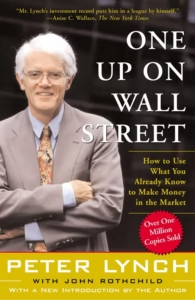
First published in 1989, One Up on Wall Street is widely regarded as one of the greatest investing books ever written. Written near the peak of his career at Fidelity Magellan, the book is Lynch’s manifesto on why individual investors can beat institutional money managers at their own game.
In clear, witty prose free of intimidating Wall Street jargon, Lynch explains how professional fund managers are restricted by rules that prevent them from buying small, undiscovered companies until those stocks have already doubled or tripled. Regular consumers, employees, and doctors, however, notice emerging trends months or years before analysts in New York skyscrapers ever see them on a spreadsheet.
Key takeaways from the book include:
- How to evaluate a company’s balance sheet using straightforward metrics like cash-to-debt ratios, inventory levels, and profit margins.
- Why boring, unglamorous businesses—such as waste management firms, funeral home operators, or bottle-cap manufacturers—often make far better investments than flashy “next big thing” tech stocks.
- How to avoid common traps like “whisper stocks” (companies with exciting promises but zero earnings) and overpriced market darlings.
Best for: Beginner to intermediate investors who want a practical, step-by-step framework for researching and selecting individual stocks.
2. Beating the Street
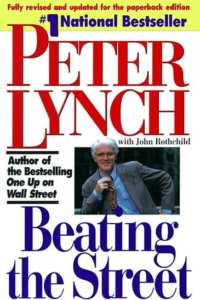
Released in 1993 after Lynch retired from managing the Magellan Fund to spend more time with his family, Beating the Street takes readers behind the scenes of his actual portfolio decisions. While One Up on Wall Street lays out the theory and tools, Beating the Street shows those tools in real-world action.
Lynch walks through twenty-one specific stock picks he recommended for Barron’s annual roundtable, dissecting what went right, what went wrong, and how he analyzed industries ranging from retail chains and restaurants to savings-and-loan banks and cyclical manufacturers. One of the book’s most famous chapters recounts his visit to St. Agnes School in Massachusetts, where a seventh-grade class outperformed the S&P 500 by picking companies they understood—like Nike, Disney, and Gap—and adhering to strict research rules.
Key takeaways from the book include:
- How to build and manage a diversified portfolio of stocks or mutual funds without constantly trading.
- Why “the best stock to buy may be the one you already own,” reinforcing the value of adding to winning positions when fundamentals remain strong.
- The twenty-five “Golden Rules” of investing summarized at the end of the book, serving as a timeless checklist for market discipline.
Best for: Investors who already grasp the basics of stock picking and want to see real case studies of fundamental analysis and portfolio management.
3. Learn to Earn: A Beginner’s Guide to the Basics of Investing and Business

Published in 1995, Learn to Earn was originally written with teenagers and young adults in mind, yet it remains one of the clearest introductions to capitalism, personal finance, and investing for adults of any age. Lynch noticed that while schools teach students how to balance a checkbook or solve algebra equations, almost no one teaches young people how companies operate, how the stock market works, or why saving early is crucial.
The book starts from the ground up, tracing the history of American business and explaining how a small idea grows into a publicly traded corporation. It breaks down how to read basic financial statements, how to evaluate corporate leadership, and why keeping money parked exclusively in low-yield savings accounts can quietly erode purchasing power over decades due to inflation.
Key takeaways from the book include:
- The power of compound interest and why starting to invest in your twenties or thirties gives you an insurmountable mathematical advantage.
- Plain-English explanations of balance sheets, income statements, dividends, and stock splits.
- Practical personal finance habits, including avoiding high-interest credit card debt before putting money into the stock market.
Best for: Complete beginners, students, and anyone looking for a jargon-free refresher on how businesses and the stock market actually work.
Comparing Peter Lynch’s Three Investing Classics at a Glance
If you are deciding which book to pick up first, the comparison below highlights how each title fits into your learning journey:
| Book Title | Publication Year | Primary Focus | Ideal Reader |
|---|---|---|---|
| Learn to Earn | 1995 | Fundamentals of capitalism, personal finance, and how companies work | Complete beginners, students, and new savers |
| One Up on Wall Street | 1989 | Identifying everyday stock opportunities, categorizing companies, and basic valuation | Everyday investors ready to research individual stocks |
| Beating the Street | 1993 | Real-world stock case studies, mutual fund strategy, and portfolio rules | Intermediate investors seeking applied stock analysis |
Reading them in order—starting with Learn to Earn, moving to One Up on Wall Street, and finishing with Beating the Street—provides a seamless progression from foundational financial literacy to confident, independent stock analysis.
How to Apply Peter Lynch’s Strategy in Today’s Market
Financial markets have evolved dramatically since 1990. Commission-free trading apps, exchange-traded funds (ETFs), and instant access to SEC filings via the internet have democratized investing in ways Lynch could only imagine. Yet human psychology has not changed at all. Fear during market sell-offs and greed during speculative bubbles still drive most investor mistakes.
You do not need to pick dozens of individual stocks to benefit from Lynch’s wisdom. Even if the core of your portfolio consists of low-cost index funds, applying Lynch’s principles to a small sleeve of individual companies—or simply using his mindset to stay calm during market corrections—can dramatically improve your results. Remember his most enduring warning: far more money has been lost by investors preparing for corrections, or trying to anticipate corrections, than has been lost in the corrections themselves.
By keeping your approach simple, staying curious about the businesses you interact with every day, and focusing on long-term earnings growth rather than daily price swings, you can put Peter Lynch’s timeless lessons to work in your own financial journey.