How Information Overload Affects Investment Decisions
Discover how too much financial information can lead to confusion and poor investment choices

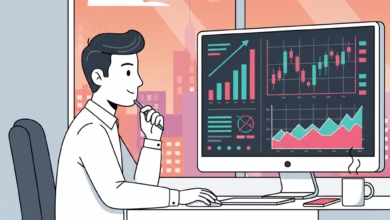
Have you ever sat down to research a single stock, only to find yourself three hours later with forty browser tabs open, watching conflicting YouTube videos, reading Reddit threads, and feeling completely paralyzed? You are not alone. In today’s hyper-connected financial markets, retail investors have access to more data, news, and analytical tools than Wall Street professionals had just two decades ago.
While having access to financial data sounds like an advantage, behavioral finance research reveals a surprising truth: more information does not automatically lead to better investment returns. In fact, once you pass a certain threshold, consuming additional market news and financial metrics actually degrades the quality of your decisions. Understanding how information overload affects investment decisions is one of the most practical steps you can take to protect your portfolio from costly emotional mistakes.
What Is Information Overload in Behavioral Finance?

Information overload occurs when the volume of available data exceeds the human brain’s cognitive capacity to process, filter, and evaluate it effectively. In traditional economics, financial models assumed that investors were perfectly rational beings who collected every available piece of data to calculate the exact value of an asset. Behavioral finance—the study of how psychology influences financial decisions—proved that this assumption does not reflect how real people actually behave.
The human brain evolved to make quick survival decisions based on limited, immediate sensory input, not to weigh thousands of fluctuating macroeconomic indicators, quarterly earnings reports, and real-time social media sentiment. When you flood your mind with too much financial data, your cognitive bandwidth gets maxed out. Instead of becoming smarter and more informed, your brain hits a bottleneck, leading to mental fatigue, confusion, and impulsive shortcuts.
The Science Behind Analysis Paralysis and Overconfidence
Researchers in psychology and behavioral economics have conducted numerous studies demonstrating what happens when investors are given too much information. One of the most famous concepts in this field comes from psychologist Paul Slovic, who studied how professional horse-race handicappers performed as they were given progressively more data about the horses.
The results were eye-opening. As the handicappers received more information, their accuracy at predicting the winner barely improved after the first few key data points. However, their confidence in their predictions skyrocketed. This phenomenon transfers directly to the stock market and personal investing:
- The Illusion of Control: Reading dozens of analyst reports and watching daily market commentary tricks your brain into believing you can predict short-term market movements, even when those movements are largely random noise.
- Analysis Paralysis: When you uncover conflicting pieces of data—such as one respected analyst predicting a market crash while another forecasts a massive rally—your brain freezes. Rather than making a reasonable, long-term choice, you delay investing altogether, missing out on years of compound growth.
- Confirmation Bias Amplification: The internet makes it effortless to find data supporting whatever opinion you already hold. If you feel nervous about the economy, an endless stream of pessimistic headlines will validate your fear, pushing you toward overly conservative choices.
How Financial Media and Social Platforms Fuel Cognitive Fatigue
Modern financial media and social networking platforms are not designed to make you a wealthier investor; they are engineered to capture and hold your attention. Understanding the business model behind financial news is essential to escaping the trap of constant consumption.
Twenty-four-hour financial news networks need fresh drama every single day to keep viewers tuned in. A routine 1.5% dip in the S&P 500 is rarely presented as normal market volatility; instead, it is framed with urgent breaking-news banners, alarming red graphics, and dramatic headlines. Similarly, financial influencers on social media platforms are rewarded by algorithms when they post bold, polarizing predictions or promote high-risk trading strategies.
When you check your brokerage app five times a day while scrolling through financial feeds, you are subjecting your brain to a continuous loop of stress hormones. This state of heightened alert impairs the prefrontal cortex—the part of your brain responsible for logical, long-term planning—and hands control over to the amygdala, which governs fear and greed.
The Hidden Costs of Too Much Market Data on Your Portfolio
Information overload is not merely an annoying mental state; it carries direct, measurable financial consequences that can quietly erode your net worth over time. Below is a comparison of how an overloaded investor typically behaves compared to a disciplined, filter-driven investor.
| Behavioral Factor | Information-Overloaded Investor | Disciplined, Filter-Driven Investor |
|---|---|---|
| Trading Frequency | High; reacts quickly to breaking news, rumors, and daily price swings. | Low; rebalances on a predetermined schedule (e.g., quarterly or annually). |
| Transaction & Tax Costs | Frequent buying and selling triggers short-term capital gains taxes and bid-ask spread losses. | Minimizes taxable events and maximizes long-term capital gains treatment. |
| Emotional Stress Level | Constantly anxious, second-guessing choices, and experiencing regret after trades. | Calm and detached from daily market headlines, focusing on multi-year goals. |
| Portfolio Strategy | Fragmented; chases recent winners and abandons assets during temporary dips. | Cohesive; adheres to a written Investment Policy Statement (IPS). |
| Long-Term Performance | Frequently underperforms benchmark indexes due to poor market timing. | Captures steady market returns through consistency and compounding. |
Overtrading and the Recency Bias Trap
One of the most expensive side effects of consuming excessive financial news is overtrading. Studies by behavioral finance professors Brad Barber and Terrance Odean famously showed that individual investors who trade the most earn significantly lower net returns than those who trade the least. Every time a new piece of information crosses your screen, it creates an urge to “do something.” Unfortunately, in investing, activity is frequently the enemy of returns.
Furthermore, constant exposure to breaking news triggers recency bias—the tendency to weigh recent events far more heavily than historical data. If a particular technology stock or sector has surged over the past three weeks and dominates every financial podcast you listen to, your brain assumes that trend will continue indefinitely, tempting you to buy at the peak.
Panic Selling and Loss Aversion
Behavioral economics has established that humans feel the pain of a financial loss roughly twice as intensely as the pleasure of an equivalent gain—a principle known as loss aversion. When you consume a steady diet of negative economic forecasts, inflation warnings, and geopolitical commentary, loss aversion goes into overdrive.
Investors suffering from information overload are far more likely to abandon a solid long-term investment plan during a routine market correction. By selling after prices have already fallen to relieve the psychological discomfort of bad news, they lock in permanent losses and frequently miss the sharpest days of the subsequent recovery.
Signal vs. Noise: Filtering What Actually Matters

To make smarter investment decisions, you need to separate signal from noise. In financial terms, signal refers to fundamental, verifiable information that genuinely impacts the long-term value of an asset or your personal financial goals. Noise is everything else—the daily chatter, speculative predictions, and short-term price fluctuations that generate excitement without providing actionable insight.
- Examples of Market Noise: Daily stock market commentary, pundit predictions about next month’s interest rate move, viral social media stock tips, intraday price charts, and sensationalist economic headlines.
- Examples of Valuable Signal: A company’s multi-year revenue growth and free cash flow trends, debt-to-equity ratios, expense ratios on index funds and ETFs, your personal savings rate, your time horizon, and your asset allocation targets.
If a piece of financial news will not matter to your portfolio five years from now, it is almost certainly noise. Learning to ignore 95% of daily financial coverage does not make you uninformed; it frees your mental energy to focus on the 5% that truly drives wealth creation.
Practical Strategies to Overcome Information Overload
You do not need to disconnect from the internet or live under a rock to become a calmer, more effective investor. Instead, you can build simple structural habits—known in behavioral finance as “choice architecture”—that protect your brain from being overwhelmed.
1. Create a Written Investment Policy Statement
Institutional investors like pension funds and university endowments rely on a formal document called an Investment Policy Statement (IPS) to keep emotions out of their decisions. You can create a simple one-page version for yourself. Write down your financial goals, your target asset allocation (for example, 80% broad market index funds and 20% bonds), how much you plan to invest each month, and the exact rules under which you will rebalance. Whenever a flood of conflicting news tempts you to make a sudden change, consult your IPS first.
2. Limit How Often You Check Your Portfolio
Checking your brokerage balance every day—or several times an hour—exposes you to high levels of short-term randomness. Over a single day, the stock market is roughly a coin flip, meaning you have nearly a 50% chance of seeing red numbers and feeling stressed. Over a ten-year period, the historical probability of positive market returns increases dramatically. Commit to checking your portfolio once a month or once a quarter, and remove brokerage apps from your smartphone’s home screen to eliminate impulsive checking.
3. Curate a Strict Information Diet
Replace real-time breaking financial news with slower, higher-quality sources of information. Unsubscribe from daily market-alert emails, mute sensationalist financial accounts on social media, and turn off push notifications on news apps. Instead, choose two or three trusted, level-headed resources—such as quarterly shareholder letters, long-form educational books on investing, or monthly economic summaries—and consume them on a set schedule.
4. Automate Your Contributions and Rebalancing
The best way to prevent cognitive fatigue from derailing your wealth-building plan is to remove daily decision-making from the equation entirely. Set up automatic transfers from your checking account into your retirement or brokerage accounts every payday—a strategy known as dollar-cost averaging. When your investments run automatically in the background, you no longer have to agonize over whether today is the “right time” to buy based on the morning headlines.
Simplicity Is Your Greatest Financial Edge

In an era where financial information is limitless and free, your scarcest resource is not data—it is your attention and emotional discipline. How information overload affects investment decisions comes down to a simple human reality: our brains were not built to process an endless stream of real-time market noise. By filtering out short-term distractions, automating your savings, and sticking to a clear long-term plan, you can turn simplicity into your greatest competitive advantage as an investor.