Can You Get a Loan While Unemployed?
What you need to know before applying for a loan without a job

The loss of a job is one of life’s most stressful events. Beyond the emotional toll, the immediate financial pressure can be overwhelming. Whether it’s an unexpected medical bill, a car repair, or just the need to bridge the gap until your next career move, you might find yourself asking: “Can I actually get a loan while I’m unemployed?”
The short answer is yes, but the process is significantly more challenging than it is for those with a steady W-2 paycheck. In the financial landscape of 2026, lenders have become more sophisticated. While they still prioritize stability, they have expanded their definition of “income” and “risk.”
In this comprehensive guide, we will explore how you can qualify for a loan without a traditional job, what alternative income sources lenders accept, and how to avoid the predatory traps that often target people in vulnerable financial positions.
What Lenders Actually Mean by “Income” (It’s Not Just a 9-to-5)

When you fill out a loan application, the “Employment Status” box is important, but the “Monthly Income” box is what truly determines your eligibility. Lenders don’t necessarily care where the money comes from; they care that it is regular, verifiable, and sufficient to cover the new debt.
In 2026, with the explosion of the gig economy and passive income streams, “unemployed” doesn’t always mean “income-less.” If you can prove that cash flows into your bank account every month from a source other than an employer, you are still a candidate for a loan.
Types of Verifiable Income That Can Help You Qualify
If you don’t have a traditional boss, you need to show the lender that you have “alternative” means of repayment. Most lenders will consider the following as valid income:
1. Unemployment Benefits
In many cases, lenders will accept government unemployment checks as income. However, they will look at the duration of the benefits. If your benefits are set to expire in two months and you are applying for a three-year loan, you will likely face a rejection.
2. Social Security and Disability Payments
If you are between jobs but receive Social Security, Supplemental Security Income (SSI), or disability payments, these are considered highly stable forms of income. Because these are government-backed, lenders often view them as more reliable than a paycheck from a startup.
3. Investment Income and Dividends
If you have a brokerage account that pays regular dividends or a retirement account (like a 401(k) or IRA) from which you are taking distributions, this counts as income. You will need to provide at least 12 months of statements to prove the consistency.
4. Rental Income
Do you own a property or even a room that you rent out? Consistent rental income, backed by a lease agreement and bank deposits, is a powerful tool for loan qualification.
5. Alimony and Child Support
Court-ordered payments for alimony or child support are legally recognized income sources. As long as you can show a history of receiving these payments on time, lenders can factor them into your Debt-to-Income (DTI) ratio.
6. Side Hustles and Freelance Work (1099)
Many people consider themselves “unemployed” because they don’t have a “job,” even though they earn $3,000 a month doing freelance graphic design or driving for a delivery app. If you have 1099 forms or tax returns showing self-employment income, you aren’t unemployed in the eyes of the bank—you are a business owner.
The Role of Credit Scores When You Don’t Have a Paystub
When a lender can’t rely on your job for security, they lean heavily on your credit score. Your score is a reflection of your “financial character.”
-
If you have a High Credit Score (740+): Lenders are much more likely to overlook your unemployment. They see a person who has a decade-long history of paying bills on time and assumes you have the savings or the resourcefulness to repay the loan.
-
If you have a Low Credit Score (Below 600): Combining unemployment with a poor credit score makes a traditional personal loan almost impossible to get. In this case, you will likely need a co-signer or collateral.
Secured vs. Unsecured Loans for the Unemployed
If you are struggling to qualify for a standard unsecured personal loan, you may need to look at Secured Loans.
Unsecured Loans (The Hard Path)
These are loans backed only by your signature. Without a job, the risk to the lender is high. If you do get approved, expect the interest rate to be significantly higher—sometimes reaching 30% APR.
Secured Loans (The Easier Path)
A secured loan requires you to put up an asset as collateral. Because the lender can seize the asset if you stop paying, they are much more willing to work with unemployed borrowers.
-
CD or Savings-Secured Loans: You borrow against your own money.
-
Auto Title Loans: (Use with extreme caution) You borrow against the equity in your car.
-
Home Equity Lines of Credit (HELOC): If you own a home, you can borrow against its value.
Warning: If you lose your job and can’t pay a secured loan, you don’t just lose your credit score—you lose your car or your house.
Using a Co-signer to Bridge the Gap

If your income is currently zero, your best chance of getting a loan with a reasonable interest rate is to use a co-signer. A co-signer is someone (usually a family member) with a steady job and a good credit score who agrees to be 100% responsible for the loan if you cannot pay.
The Pro-Tip for Co-signers:
In 2026, many lenders offer a “Co-signer Release” option. This means that once you find a new job and make a certain number of on-time payments (usually 12 to 24), the co-signer can be legally removed from the loan, protecting their credit from your future risks.
Where to Look: Best Lender Types for Non-Traditional Borrowers
Not all financial institutions have the same rules. If you are unemployed, skip the big national banks and try these:
-
Online Fintech Lenders: Companies like Upstart use AI to look at “alternative data,” such as your education and your field of work. If you are an unemployed software engineer, the AI knows you are likely to be employed again soon and may approve your loan.
-
Credit Unions: Since they are member-owned, credit unions are more flexible. If you have been a member for years, a loan officer might look at your overall history with the branch rather than just your current employment status.
-
Peer-to-Peer (P2P) Platforms: Sites like Prosper allow individual investors to fund your loan. You can often write a “pitch” explaining your situation, and an investor might decide to take a chance on you.
Dangerous “No-Income” Loans to Avoid
When you are stressed about money, predatory lenders will come out of the woodwork with “guaranteed approval” offers. Stay away from these:
-
Payday Loans: These are short-term loans with APRs that can exceed 400%. They are designed to trap you in a cycle of debt.
-
High-Interest Title Loans: If the interest rate is 100%, and you are already unemployed, the chances of you losing your car are extremely high.
-
“Quick Cash” Apps with Hidden Fees: Some apps offer “advances,” but once you factor in the “tips” and “subscription fees,” the cost is higher than a credit card.
5 Steps to Take Before Applying for a Loan Without a Job

To increase your chances of a “Yes,” do this before hitting submit:
-
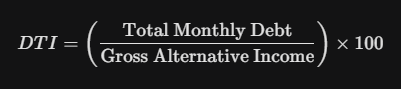
Calculate Your DTI Ratio: Even without a job, your total debt payments should not exceed 36% to 43% of your alternative income.
-
Clean Up Your Credit Report: Dispute any errors. A 20-point boost could be the difference between approval and rejection.
-
Gather Every Shred of Proof: Have your tax returns, 1099s, bank statements, and benefit letters ready in a digital folder.
-
Lower Your Request: Don’t ask for $20,000 if you only need $5,000. Lenders are more comfortable with smaller risks during unemployment.
-
Check for Pre-Qualification: Only use lenders that offer a “soft pull.” You don’t want to damage your credit score with a “hard inquiry” just to be told no.
Alternatives to Traditional Loans During Unemployment
Before you take on new debt, consider these alternatives that don’t involve a bank:
-
0% APR Credit Cards: If you still have a good credit score, you might qualify for a credit card with a 0% introductory rate for 12–18 months. This is effectively an interest-free loan, provided you can pay it back before the teaser rate expires.
-
401(k) Loans: You are essentially borrowing from yourself. There is no credit check, but if you don’t pay it back, you face heavy taxes and penalties.
-
Community Aid and Non-Profits: Organizations like the United Way or local religious groups often have “emergency funds” for people between jobs that don’t need to be repaid.
-
Negotiating with Current Creditors: Sometimes, you don’t need a new loan; you just need your current payments to stop. Ask your current lenders about “Hardship Forbearance.”
Borrowing with Caution
Getting a loan while unemployed is possible, but it requires a strategic approach and a clear understanding of your own “alternative income.” In 2026, the lenders are there, but the “safety net” is yours to build.
Always remember: A loan is a commitment. If you aren’t sure when your next paycheck is coming, taking on debt should be your absolute last resort. Use the tools available—Fintech, credit unions, and co-signers—but keep your borrowing to the bare minimum. Your goal is to survive this transition, not to start your next job in a mountain of debt.