Loans
15-Year vs. 30-Year Mortgage Amortization: What’s the Difference?
Understand how 15-year and 30-year mortgages differ in payments, total interest, and long-term costs
Buying a home is arguably the single largest financial commitment you will make in your lifetime. For most buyers, stepping onto the property ladder requires securing a mortgage. When you sit down with a lender or browse real estate listings, one of the most consequential decisions you will face isn’t just finding the right neighborhood or the perfect kitchen—it is choosing your loan term.
The two heavyweights of the residential mortgage world are the 30-year fixed-rate mortgage and the 15-year fixed-rate mortgage. At first glance, the choice might seem simple: a shorter loan means you pay off your home faster, while a longer loan gives you smaller monthly payments. However, beneath the surface lies a complex web of interest calculations, cash flow implications, wealth-building opportunities, and long-term financial security considerations.
Understanding how mortgage amortization works—and how your choice of loan term drastically alters your financial trajectory—is critical. In this comprehensive guide, we will break down the mechanics of 15-year and 30-year mortgage amortization, examine the real financial trade-offs, explore how interest rates play a pivotal role, and help you determine which option aligns best with your personal financial goals.
What Is Mortgage Amortization and How Does It Work?

Before comparing loan terms, it is essential to understand what amortization actually means. In plain English, amortization is the process of gradually paying off a debt over time through regular, scheduled payments. Each monthly mortgage payment you make is split into two distinct components: principal and interest.
-
Principal: The actual amount of money you borrowed from the lender to buy the home.
-
Interest: The fee charged by the lender for the privilege of borrowing that money, calculated as a percentage of the remaining loan balance.
The Anatomy of an Amortization Schedule
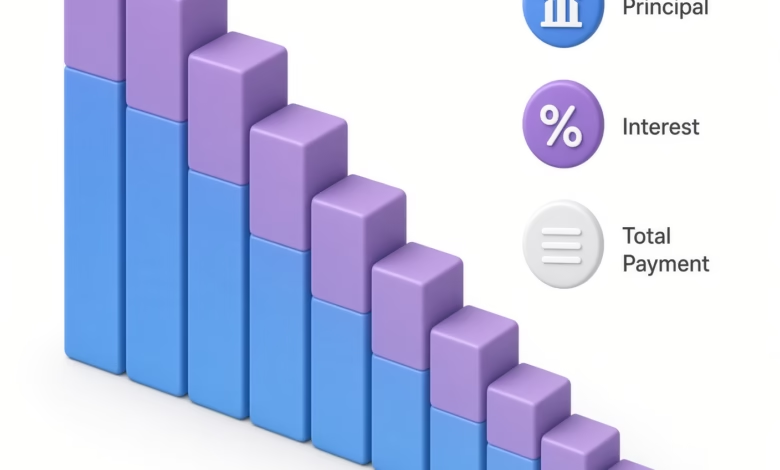
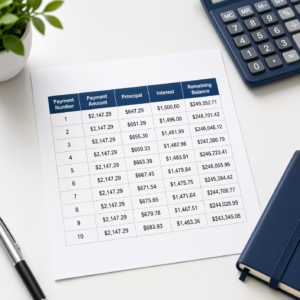
An amortization schedule dictates how every dollar of your monthly payment is allocated over the life of the loan. In the early years of a mortgage—regardless of whether it is a 15-year or 30-year term—a disproportionately large percentage of your monthly payment goes toward interest, while a very small portion reduces your principal balance.
As time goes on, the balance shifts. Because your remaining principal decreases with every payment, the interest calculated for the following month is slightly lower. Consequently, more of your fixed monthly payment goes toward paying down the principal.
To visualize this, imagine a 30-year mortgage for four hundred thousand dollars at a standard interest rate. In the first few years, over seventy percent of your monthly payment might vanish into interest charges. By year twenty, that ratio flips, and the majority of your payment finally chips away at the principal. Understanding this front-loaded interest structure is the key to grasping why 15-year and 30-year mortgages behave so differently over time.
Deep Dive Into the 30-Year Fixed-Rate Mortgage
The 30-year fixed-rate mortgage is the undisputed king of the American housing market. It is the default choice for the vast majority of homebuyers, and for good reason. Its primary superpower is monthly affordability.
How the 30-Year Term Works
With a 30-year loan, your debt is spread across 360 monthly payments. Because the repayment window is stretched over three decades, the principal amount is sliced into much smaller increments compared to a shorter loan. This results in a significantly lower monthly principal-and-interest payment, making homeownership accessible to a wider demographic of buyers. Furthermore, because the interest rate is “fixed,” your principal and interest payment remains locked and predictable for the entire thirty years, shielding you from inflation and market volatility.
Pros of a 30-Year Mortgage
-
Lower Monthly Payments: The most significant advantage is cash flow management. A lower monthly obligation leaves room in your budget for other essential expenses, retirement savings, emergency funds, and discretionary spending.
-
Buying Power: Because monthly payments are lower, you qualify for a larger loan amount. This expands your housing options in competitive real estate markets.
-
Financial Flexibility: In times of economic uncertainty, job loss, or unexpected medical expenses, having a lower mandatory housing payment acts as a financial cushion. It is much easier to service a smaller monthly debt than a stretched-one.
-
Inflation Hedging: Over thirty years, inflation generally erodes the real value of your fixed mortgage payment. A payment that feels substantial today will feel much lighter twenty years from now.
Cons of a 30-Year Mortgage
-
Massive Interest Costs: Stretching payments over thirty years means you pay interest for a much longer duration. Over the life of the loan, total interest payments can easily equal or even exceed the original purchase price of the home.
-
Slower Equity Building: Because payments are spread thin, your home equity accumulates at a glacial pace during the first decade. If you need to sell the home after five or seven years, you may find that most of your payments went to interest rather than building real wealth.
-
Extended Debt Commitment: Carrying a mortgage deep into your working life or retirement years can weigh heavily on your psychological and financial peace of mind.
Deep Dive Into the 15-Year Fixed-Rate Mortgage
The 15-year fixed-rate mortgage is the disciplined sibling of the 30-year loan. It compresses the entire repayment timeline into 180 monthly payments. While it requires a higher financial commitment each month, it rewards borrowers with staggering long-term savings.
How the 15-Year Term Works
A 15-year mortgage accelerates the amortization process aggressively. Because you are paying off the exact same principal in half the time, the monthly principal portion of your payment is drastically larger. To make matters even more attractive, lenders typically reward 15-year borrowers with lower interest rates compared to 30-year loans—often by a margin of 0.25% to 0.75%. This occurs because lenders assume significantly less risk when locking in capital for a shorter duration.
Pros of a 15-Year Mortgage
-
Enormous Interest Savings: Because the loan duration is cut in half and the interest rate is typically lower, you will pay tens or even hundreds of thousands of dollars less in total interest over the life of the loan.
-
Rapid Wealth Accumulation: Equity builds at an accelerated pace. Every single month, a massive chunk of your payment directly increases your net worth by reducing your debt.
-
Debt-Free Freedom: Owning your home outright in fifteen years frees up massive amounts of monthly cash flow right when you might be approaching retirement or peak career earning years.
-
Inherent Discipline: A 15-year mortgage acts as a forced savings plan. You cannot skip or reduce your payment, ensuring that you systematically build home equity whether you feel like saving or not.
Cons of a 15-Year Mortgage
-
High Monthly Payments: The most obvious drawback is the sheer size of the monthly bill. Your principal-and-interest payment will be substantially higher than a 30-year equivalent, which can strain your monthly budget.
-
Reduced Purchasing Power: Because your monthly debt-to-income ratio limits how much you can borrow, a 15-year mortgage may force you to buy a smaller home, compromise on location, or bring a much larger down payment to the closing table.
-
Strict Cash Flow Constraints: With a higher mandatory housing payment, you have less breathing room if your financial situation changes. An unexpected job transition or income drop could turn a manageable budget into a stressful emergency.
Side-by-Side Financial Comparison: Monthly Payments and Total Interest
To truly understand the difference between a 15-year and 30-year mortgage, we need to look at concrete numbers. Let us examine a hypothetical scenario involving a $400,000 mortgage.
-
Scenario A (30-Year Fixed):
-
Loan Amount: $400,000
-
Interest Rate: 6.5%
-
Monthly Principal & Interest Payment: ~$2,528
-
Total Interest Paid Over 30 Years: ~$510,000
-
Total Cost (Principal + Interest): ~$910,000
-
-
Scenario B (15-Year Fixed):
-
Loan Amount: $400,000
-
Interest Rate: 5.8% (reflecting the typical lower rate for shorter terms)
-
Monthly Principal & Interest Payment: ~$3,323
-
Total Interest Paid Over 15 Years: ~$198,000
-
Total Cost (Principal + Interest): ~$598,000
-
Analyzing the Numbers
In this realistic comparison, choosing the 15-year mortgage increases your monthly payment by $795. However, by committing to that higher monthly payment, you save over $310,000 in pure interest charges and own your home free and clear fifteen years sooner.
This financial gulf is the central dilemma of mortgage selection: Is the extra $795 a month better kept in your monthly budget for investments, emergencies, and lifestyle, or is it better deployed into eliminating debt and capturing massive interest savings?
The Impact of Interest Rates on Your Amortization Choice
Interest rates are the invisible gears that drive the mechanics of mortgage amortization. When macroeconomic conditions shift, the math between 15-year and 30-year mortgages changes dramatically.
The Spread Between 15-Year and 30-Year Rates
Historically, 15-year mortgage rates track lower than 30-year rates. When federal monetary policy keeps interest rates low, the gap might feel narrow. However, in high-interest-rate environments, that spread widens. A wider spread makes the 15-year mortgage even more financially attractive because the incentive to avoid high long-term interest accrual becomes paramount.
How Rate Fluctuations Alter Risk
When interest rates are exceptionally low, locking in a 30-year mortgage becomes an incredible strategic advantage. Why? Because you can secure cheap, long-term debt while taking your excess cash flow and investing it in higher-yielding assets like index funds, retirement accounts, or real estate. Conversely, when interest rates are high, locking in a 30-year mortgage means paying a steep price for money over three decades, making the aggressive debt elimination of a 15-year term far more enticing.
Cash Flow Flexibility vs. Wealth Building: Which Matters More?

Financial advisors often find themselves divided into two distinct camps when debating 15-year versus 30-year mortgages: the cash-flow preservationists and the debt-elimination purists.
The Case for Cash Flow Flexibility
Proponents of the 30-year mortgage argue that cash is king. Life is unpredictable. Job losses, health crises, career changes, and family expansions happen. By choosing a 30-year mortgage, you establish a lower baseline cost of living.
Furthermore, financial planners often point out the concept of opportunity cost. If you take a 30-year mortgage and invest the monthly difference in a diversified portfolio that outperforms your mortgage interest rate, you could theoretically build more overall wealth than you would by simply sinking extra cash into your house walls. Your home is an illiquid asset; cash in a brokerage account or retirement fund offers liquidity and flexibility that equity locked in a home simply cannot match.
The Case for Aggressive Wealth Building
On the other side of the coin, proponents of the 15-year mortgage argue that human behavior often trumps spreadsheet math. While investing the difference sounds great in theory, many people succumb to lifestyle inflation—spending the extra monthly cash flow on depreciating consumer goods rather than disciplined investing.
A 15-year mortgage enforces financial discipline. It treats your monthly housing payment as a mandatory wealth-building vehicle. Once the home is paid off in fifteen years, your housing costs drop overnight to just property taxes and insurance, liberating immense amounts of cash flow for your peak retirement years. For risk-averse individuals, the psychological peace of mind that comes with absolute debt freedom is worth far more than theoretical stock market returns.
Hidden Costs and Risks to Consider Beyond the Principal
When calculating whether you can afford a 15-year or 30-year mortgage, looking solely at the principal and interest payment is a dangerous mistake. Your true monthly housing cost—often referred to as PITI—includes several other crucial elements:
-
Property Taxes: Levied by local governments and varying wildly by state and municipality. These taxes adjust upward over time as property values rise.
-
Homeowner’s Insurance: Protecting your physical structure against fire, storms, and liability. Insurance premiums have risen sharply across the country due to climate risks and inflation.
-
Homeowners Association (HOA) Fees: If your property is located in a planned community, condo building, or managed neighborhood, monthly or annual HOA fees are mandatory.
-
Private Mortgage Insurance (PMI): If your down payment is less than 20%, lenders will require PMI, adding a monthly fee to your payment until your equity reaches the 20% threshold.
Failing to account for these ancillary costs can easily lead to becoming “house poor”—a situation where your home consumes such a massive percentage of your income that you have little money left for food, transportation, savings, or emergencies. When evaluating a 15-year mortgage, you must ensure that your higher principal-and-interest payment does not squeeze out your ability to comfortably cover PITI and maintain a robust emergency fund.
Can You Turn a 30-Year Mortgage Into a 15-Year Mortgage? (The Hybrid Strategy)
What if you want the best of both worlds? What if you want the aggressive interest savings of a 15-year mortgage, but you also want the safety net and cash flow flexibility of a 30-year mortgage?
Fortunately, there is a popular and highly effective workaround: getting a 30-year fixed-rate mortgage and making voluntary, unscheduled principal-only payments.
How the Hybrid Strategy Works
When you sign up for a 30-year mortgage, your lender establishes a binding minimum monthly payment. However, virtually all reputable modern lenders allow you to pay more than that minimum amount each month without penalty.
If you take out a 30-year mortgage with a $2,528 minimum payment, but you purposefully send $3,323 every single month—matching what a 15-year payment would have been—you actively mimic the amortization schedule of a 15-year loan.
The Ultimate Advantage: Forced Flexibility
The beauty of this hybrid strategy is optionality.
-
In months when your finances are robust, you pay the higher amount, slashing your principal and shrinking your overall loan timeline.
-
If you experience an emergency, a job change, or a lean month, you are under no contractual obligation to pay the higher amount. You can legally drop your payment back down to the lower 30-year minimum without facing default, foreclosure, or penalty.
The only slight downside to this strategy is that your baseline interest rate on a 30-year loan will typically be slightly higher than if you had qualified for a dedicated 15-year loan from day one. For many homeowners, paying that fractional interest rate premium is a small price to pay for the ultimate insurance policy of cash-flow flexibility.
Making the Right Choice for Your Financial Future

Choosing between a 15-year and a 30-year mortgage amortization schedule is not merely a mathematical exercise; it is a profound lifestyle and financial decision.
If your income is rock-solid, your emergency fund is fully stocked, and your primary psychological goal is absolute freedom from debt as quickly as possible, the 15-year fixed-rate mortgage is an exceptional wealth-building tool that will save you hundreds of thousands of dollars in interest.
If you value maximum monthly cash flow, want protection against unforeseen economic turbulence, or prefer to maintain liquid capital for diverse investment opportunities, the 30-year fixed-rate mortgage—or the hybrid strategy of making voluntary extra principal payments on a 30-year loan—provides the flexibility and security you need.
Take a hard look at your monthly budget, assess your long-term career stability, and choose the path that allows you to build home equity without sacrificing your overall financial health and peace of mind.