Financial Security
7 Ways to Protect Your Money From Financial Scams
Learn how to identify warning signs and build safer financial habits to avoid costly scams
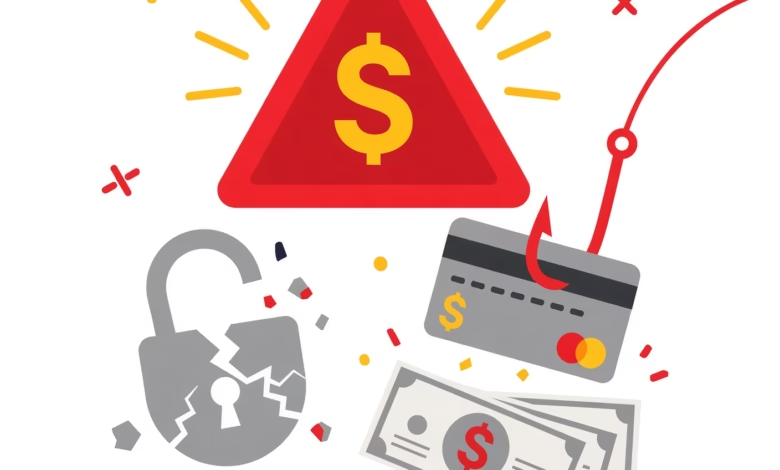
Financial fraud has evolved far beyond the clumsy, obvious phishing emails of the past. Today’s scammers employ sophisticated artificial intelligence, deepfake audio, multi-layered social engineering, and automated digital traps designed to siphon life savings in minutes. As the financial ecosystem becomes increasingly digitized, safeguarding your hard-earned capital requires more than basic caution; it demands a proactive, multi-tiered defense strategy.
Whether you are managing a growing investment portfolio, running a small business, or simply trying to secure your personal checking account, understanding the anatomy of modern fraud is critical. Below are seven advanced, actionable strategies to fortify your financial perimeter and ensure your money remains yours.
1. Implement Zero-Trust Identity Verification Across All Financial Accounts

The concept of “zero-trust” originated in cybersecurity architecture, but it is equally vital for personal financial security. Zero-trust dictates that no entity—whether an individual, a device, or a communication channel—should be trusted by default, regardless of prior verification.
When dealing with financial institutions, asset managers, or wire transfers, treat every inbound request as a potential threat until proven otherwise through out-of-band verification. Scammers frequently spoof caller IDs, email addresses, and even corporate domain names to impersonate trusted authorities such as your bank’s fraud department, the IRS, or a business partner.
To put zero-trust into practice:
-
Establish Independent Verification Channels: If you receive an urgent call or message claiming your account has been compromised, do not use the phone number provided in the message or redial the incoming caller ID. Hang up and manually dial the official customer service number printed on the back of your debit card or retrieved from your bank’s verified website.
-
Use Passwordless Authentication and Hardware Keys: Traditional passwords and SMS-based two-factor authentication (2FA) are increasingly vulnerable to SIM-swapping and interception attacks. Upgrade your critical financial portals to FIDO2-compliant hardware security keys (such as YubiKeys) or robust authenticator apps. Hardware keys make credential phishing virtually impossible because they require physical presence and cryptographic domain validation.
-
Incorporate Multi-Party Authorization for High-Value Transactions: If you manage corporate funds or high-net-worth family accounts, require dual-approval processes for any wire transfers, automated clearing house (ACH) transactions, or significant account profile changes.
2. Deploy Behavioral Biometrics and Financial Monitoring Tools
Reactive security—checking your bank statement at the end of the month—is no longer sufficient. By the time you notice an unauthorized transaction, the funds may have already moved through a complex web of cryptocurrency exchanges or overseas accounts, making recovery nearly impossible. Proactive defense requires real-time behavioral monitoring.
Modern financial security involves leveraging software and account features that monitor not just who is logging into your account, but how they are interacting with it.
-
Set Granular Real-Time Transaction Alerts: Configure your banking apps, credit card portals, and investment accounts to send instant push notifications or SMS alerts for every single transaction, regardless of size. Pay special attention to alerts for profile modifications, such as changes to your mailing address, phone number, or password reset requests.
-
Leverage Credit and Identity Monitoring Services: Utilize comprehensive credit monitoring tools that track inquiries, new account openings, and changes to your credit bureau files across all major reporting agencies (Equifax, Experian, and TransUnion).
-
Freeze Your Credit Files: One of the most effective preventive measures against identity theft is placing a credit freeze on your files with all major bureaus. A freeze prevents lenders from opening new lines of credit in your name. You can temporarily lift or thaw the freeze whenever you legitimately need to apply for credit or financing.
3. Master the Psychology of Social Engineering and AI-Driven Impersonation
The vast majority of financial scams do not succeed because the technology was breached; they succeed because human psychology was manipulated. Scammers weaponize cognitive biases such as urgency, fear, greed, and authority to bypass rational decision-making.
With the proliferation of generative artificial intelligence, fraud has entered a terrifyingly realistic era. Cybercriminals can now clone the voice of a family member, a CEO, or a trusted financial advisor using just a few seconds of audio extracted from social media videos. Similarly, deepfake video technology allows fraudsters to conduct live video calls impersonating trusted professionals.
To counteract psychological manipulation and AI-enabled deception:
-
Establish a Family or Business Code Word: Agree upon a unique, unguessable verbal passcode with close family members, business partners, or key employees. If someone calls claiming to be a relative in an emergency or a boss requesting an urgent wire transfer, ask them for the code word. If they cannot provide it immediately, terminate the communication.
-
Recognize Red Flags of Urgency: Fraudsters invariably manufacture artificial time constraints. Phrases like “Act now or your account will be closed,” “This investment opportunity expires in one hour,” or “Do not tell anyone about this transfer because it’s a covert investigation” are hallmark indicators of manipulation. Legitimate financial institutions will never pressure you to bypass security protocols under duress.
-
Verify Changes in Payment Instructions: If you receive an email from a contractor, vendor, or real estate title company stating that their banking details have changed for an upcoming payment, treat it as high-risk. Always verify the change by calling a previously established, trusted phone number—not the number listed in the suspicious email.
4. Secure Your Digital Infrastructure and Communication Channels
Your financial security is only as strong as the digital devices and networks you use to access your wealth. If a hacker intercepts your communications or gains remote access to your laptop, your bank accounts, brokerage platforms, and cryptocurrency wallets are immediately compromised.
Securing your personal digital infrastructure requires a disciplined approach to device hygiene and network security.
-
Isolate Financial Activities on Dedicated Devices: Whenever possible, designate a specific, highly secured device—such as a clean laptop or a dedicated smartphone—strictly for banking, investing, and financial management. Avoid using this device for casual web browsing, downloading unverified software, or clicking on social media links.
-
Eliminate SMS Vulnerabilities: Contact your mobile carrier and place a strict port-freeze or SIM-lock on your account. This prevents unauthorized individuals from convincing your carrier to transfer your phone number to a rogue SIM card, which is the primary vector for bypassing SMS-based two-factor authentication.
-
Utilize Encrypted Communication Channels: For sensitive financial discussions with advisors, accountants, or family members, avoid standard, unencrypted email or text messaging. Utilize end-to-end encrypted messaging applications or secure client portals provided by certified financial institutions.
5. Navigate Investment Fraud and Fake Wealth-Building Traps

As economic landscapes shift, fraudsters continuously invent new investment vehicles and wealth-building schemes designed to exploit public anxiety and the desire for financial freedom. From sophisticated cryptocurrency “pig butchering” scams to fake private equity funds and high-yield promissory notes, investment fraud costs victims billions of dollars annually.
These schemes often begin innocently—through accidental text messages, social media networking groups, or dating applications—before gradually pivoting into high-pressure pitches promising guaranteed, risk-free returns.
To protect your capital from fraudulent investment schemes:
-
Understand the Risk-Return Paradox: In legitimate financial markets, high returns are invariably correlated with high risk. Any platform, individual, or investment opportunity promising “guaranteed high returns with zero risk” is, without exception, a scam.
-
Verify Regulatory Registration: Before investing capital with any advisor, broker, or fund, independently verify their credentials. In the United States, use the Financial Industry Regulatory Authority’s (FINRA) BrokerCheck tool and the Securities and Exchange Commission’s (SEC) Investment Adviser Public Disclosure (IAPD) database to confirm licensing, disciplinary history, and regulatory standing.
-
Conduct Independent Asset Custody Checks: Never wire money directly to an individual, a private wallet, or an obscure shell company. Legitimate investment assets are held by independent, regulated custodians (such as major trust companies or established brokerage firms) where account statements are issued directly by the custodian, not the investment manager.
6. Fortify Estate, Inheritance, and Elder Financial Protection
As individuals age, they frequently become prime targets for financial exploitation, ranging from predatory scams perpetrated by strangers to financial abuse by unscrupulous acquaintances or caregivers. Protecting long-term wealth requires proactive estate planning and legal safeguards designed to protect vulnerable periods of life.
Elder financial abuse often goes unreported because victims feel ashamed, confused, or dependent on the perpetrator. Establishing legal frameworks well in advance ensures that your accumulated wealth remains protected under any circumstance.
-
Designate a Trusted Contact: Major financial institutions now allow account holders to name a “trusted contact.” This is an individual you authorize the institution to contact if they notice suspicious account activity, potential cognitive decline, or signs of financial exploitation. Crucially, a trusted contact does not have the authority to execute transactions on your account; their sole role is to act as a communication bridge.
-
Execute Durable Powers of Attorney Carefully: Granting power of attorney (POA) is a significant legal step. Ensure you assign a durable financial POA to a meticulously vetted, highly trustworthy individual, and consider incorporating checks and balances, such as requiring regular account audits or dual oversight by an independent professional, such as a certified public accountant (CPA).
-
Educate Family Members on Common Fraud Tactics: Financial literacy is a generational shield. Regularly discuss emerging fraud trends with aging parents, teenage children, and other family members to normalize skepticism and open communication regarding money matters.
7. Establish a Rapid Incident Response and Recovery Protocol

Even with the most rigorous security measures in place, the sophisticated nature of modern financial crime means that no individual is entirely immune. If you suspect you have been targeted by a scam or that your financial information has been compromised, every minute of delay significantly reduces the likelihood of recovering your funds.
Having a pre-formulated, step-by-step incident response plan ensures you act decisively rather than panicking during a crisis.
-
Immediately Contact Your Financial Institutions: If unauthorized transactions have occurred or credentials have been exposed, call your bank, credit card issuer, or brokerage firm immediately. Request that they freeze the compromised accounts, cancel debit and credit cards, and flag the profile for suspicious activity. Ask the institution to initiate a recall or reversal for any recent unauthorized wire transfers or ACH transactions.
-
File Official Regulatory Reports: Documenting the fraud is essential for both potential recovery and law enforcement tracking. File formal complaints with relevant federal agencies, such as the Federal Bureau of Investigation’s Internet Crime Complaint Center (IC3) and the Federal Trade Commission (FTC). If identity theft is involved, file a report with your local police department to obtain an official police report, which creditors often require to clear fraudulent debts.
-
Secure Your Digital Perimeter Post-Incident: If a scammer gained access to your computer or online accounts, assume all devices and credentials are compromised. Immediately change every password across your digital ecosystem, perform a deep malware and antivirus scan on all hardware, revoke unauthorized third-party application permissions connected to your email and financial portals, and monitor your credit reports closely for the subsequent 12 to 24 months.
Protecting your financial future requires shifting from a mindset of passive trust to one of active vigilance. By implementing zero-trust verification, embracing behavioral monitoring, recognizing psychological manipulation, and maintaining a rapid incident response framework, you can build an impenetrable fortress around your wealth and navigate the modern digital economy with confidence and peace of mind.