5 Finance Books That Teach Different Lessons About Wealth
Explore five finance books with different perspectives on building wealth

Building wealth is rarely a one-size-fits-all journey. If you ask ten self-made millionaires how they achieved financial freedom, you will likely get ten completely different answers. Some rely on aggressive entrepreneurship, while others build quiet fortunes by investing in low-cost index funds over several decades. Some view money as a psychological puzzle, while others see it as a mathematical equation.
Because wealth creation has so many dimensions, reading just one finance book will not give you the whole picture. To build a solid financial foundation, you need to understand cash flow, human psychology, quiet frugality, index fund investing, and personal values.
In this guide, we break down five classic finance books that offer vastly different—yet equally powerful—lessons about wealth. Whether you are just starting your financial journey or looking to refine your money management strategy, these literary cornerstones will transform how you view money forever.
1. Rich Dad Poor Dad by Robert Kiyosaki: The Difference Between Assets and Liabilities
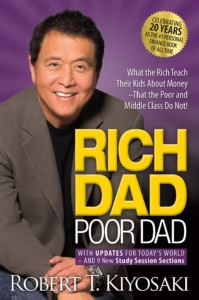
Published in 1997, Rich Dad Poor Dad remains one of the most influential personal finance books in modern history. Robert Kiyosaki frames his financial lessons around a narrative of two fathers: his biological father (Poor Dad), who was highly educated, earned a steady salary, but struggled financially; and his best friend’s father (Rich Dad), a high-school dropout who built a vast business and real estate empire.
The Core Lesson: Acquire Assets, Not Liabilities
The primary takeaway from Kiyosaki’s book is remarkably simple: rich people acquire assets, while the poor and middle class acquire liabilities that they mistaken for assets.
Kiyosaki defines these terms in plain, easy-to-understand language:
- An Asset: Anything that puts money into your pocket (e.g., rental properties, stocks, dividend-paying bonds, intellectual property).
- A Liability: Anything that takes money out of your pocket (e.g., car loans, credit card balances, personal mortgages, subscriptions).
Many middle-class individuals believe that their primary residence is their largest financial asset. Kiyosaki challenges this long-held belief by pointing out that a primary residence requires monthly mortgage payments, property taxes, maintenance fees, and insurance—meaning it consistently drains cash flow until it is sold.
Key Mindset Shifts from the Book
Instead of working for money your entire life, your goal should be to build or acquire income-generating assets that work for you. Once your passive cash flow exceeds your monthly living expenses, you attain true financial independence.
Main Takeaway: Stop measuring your financial success by the size of your paycheck. Focus instead on acquiring assets that generate cash flow regardless of whether you go to work tomorrow.
2. The Psychology of Money by Morgan Housel: How Behavior Trumps Knowledge
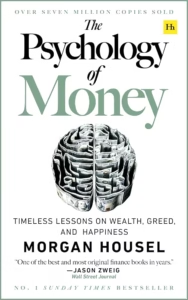
While traditional financial literature focuses heavily on numbers, charts, and stock valuation formulas, Morgan Housel’s The Psychology of Money takes a radically different approach. Housel argues that doing well with money has very little to do with how smart you are and everything to do with how you behave.
The Core Lesson: Financial Success Is a Soft Skill
You can hold a doctorate in finance from an Ivy League university, but if you lack emotional control, you can easily blow your wealth through panic selling, leverage, or unbridled greed. Conversely, an ordinary worker with no formal financial education can build substantial wealth simply by remaining patient, disciplined, and calm during market downturns.
Housel explores several psychological traps that trip up everyday investors:
- Moving the Goalposts: The dangerous habit of increasing your expectations every time your income rises. If your appetite for luxury grows as fast as your earnings, you will never feel rich or secure.
- The Power of Compounding: Understanding that extraordinary results do not require extraordinary effort; they simply require immense amounts of time. Counterintuitively, over 99% of Warren Buffett’s accumulated net worth was generated after his 50th birthday.
- Reasonable vs. Rational: Aiming to be emotionally “reasonable” with your financial decisions is often better than trying to be strictly mathematical or cold-bloodedly “rational”. A plan you can stick with during scary times is far superior to a theoretically perfect plan you abandon in a crisis.
Freedom as the Ultimate Dividend
One of the most profound chapters in the book focuses on the true value of wealth. Housel highlights that the highest form of wealth is the ability to wake up every morning and say, “I can do whatever I want today.” Money’s greatest intrinsic value is giving you control over your time, flexibility in your schedule, and peace of mind during unexpected life emergencies.
Main Takeaway: Financial literacy is not just math; it is behavioral control. Wealth is what you do not see—it is the cars not purchased, the jewelry not worn, and the options you retain for your future self.
3. The Millionaire Next Door by Thomas J. Stanley and William D. Danko: The Power of Quiet Frugality
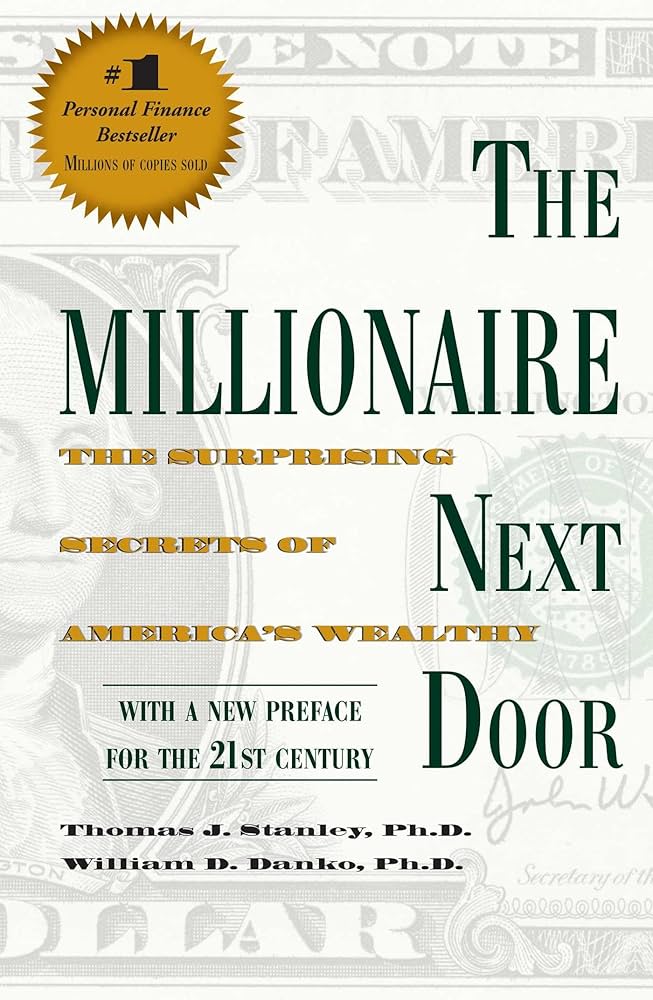
When most people picture a millionaire, they imagine high-end sports cars, massive mansions, tailored suits, and expensive luxury watches. In The Millionaire Next Door, researchers Thomas J. Stanley and William D. Danko debunk this popular pop-culture myth using decades of empirical research and extensive statistical surveys.
The Core Lesson: High Income Does Not Equal High Wealth
The authors uncover a sharp distinction between being a high earner and being truly wealthy. Many people living in upscale neighborhoods with high salaries are actually living paycheck-to-paycheck because they spend nearly everything they earn to maintain an impressive hyper-consumerist lifestyle.
The study divides individuals into two distinct financial categories:
- PAWs (Prodigious Accumulators of Wealth): Individuals who excel at building net worth. They consistently save a large percentage of their income, invest carefully, and live well below their financial means.
- UAWs (Under Accumulators of Wealth): High earners who display high-status symbols but accumulate minimal actual capital. They consume their wealth through depreciating consumer items instead of accumulating wealth-building assets.
Characteristics of America’s Real Millionaires
The research revealed that the average millionaire in the United States does not live in an exclusive gated community. Instead, they tend to be middle-class small business owners, managers, or steady professionals who live in modest neighborhoods, drive reliable used cars, shop with budgets, and prioritize long-term financial security over immediate status display.
Their wealth accumulation comes down to three basic principles:
- They allocate their time, energy, and money efficiently toward building net worth.
- They prioritize financial independence over social status.
- Their parents did not provide economic outpatient care (financial hand-outs) in adulthood, fostering total financial self-reliance.
Main Takeaway: Real wealth is invisible. It is built through quiet discipline, sustained frugality, and ignoring societal pressure to keep up appearances.
4. The Simple Path to Wealth by JL Collins: The Low-Stress Guide to Index Fund Investing
The investment world is notoriously cluttered with complex jargon, day-trading tactics, confusing financial products, and high-fee advisors. In The Simple Path to Wealth, JL Collins sweeps away all the noise to deliver one of the clearest, most actionable blueprints for building wealth ever written.
The Core Lesson: Simplicity Beats Complexity Every Time
Originally written as a series of letters to his daughter to help her manage money without having to spend her life studying finance, Collins’ message is clear: complex investments are designed primarily to enrich Wall Street brokers, not you. A simple, low-cost approach is not only easier to manage, but it also consistently outperforms active stock picking over the long run.
Collins advocates for a straightforward investment strategy focused on three major components:
- Avoid Debt at All Costs: High-interest debt (like credit card debt) is a financial emergency that destroys your ability to compound wealth. Pay it off aggressively before pursuing major investment strategies.
- Embrace Broad-Market Index Funds: Instead of attempting to pick individual winning stocks, invest in low-cost total stock market index funds (such as funds tracking the S&P 500 or the total US stock market). Buying an index fund lets you instantly own a tiny piece of hundreds or thousands of the world’s best companies.
- Build “F-You Money”: Accumulate enough savings and investments to earn total independence from any employer, toxic work environment, or unexpected financial setback.
Navigating Stock Market Volatility
One of the book’s strongest sections focuses on investor behavior during market crashes. Collins explains that stock market declines are not unexpected disasters; they are a normal, regular feature of financial markets. When the market drops 20%, 30%, or 50%, the secret to success is simply holding your position and continuing to buy index funds at a discount.
Main Takeaway: You do not need to analyze complex balance sheets or trade stocks daily to get rich. Live on less than you make, eliminate debt, buy low-cost total market index funds, and let market growth do the heavy lifting over time.
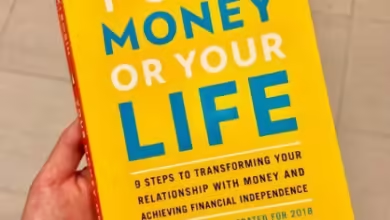
5. Your Money or Your Life by Vicki Robin and Joe Dominguez: Redefining Wealth Through Time and Energy
Most personal finance books treat money as an end goal. Your Money or Your Life, written by Vicki Robin and Joe Dominguez, approaches money from a holistic, philosophy-driven perspective. It asks a deep question: What are you actually trading when you spend money?
The Core Lesson: Money Is Life Energy
The central premise of the book is that money is simply something you trade your finite life energy for. Every dollar you spend represents a fraction of your time on Earth—time spent working at a job, commuting, enduring workplace stress, and missing out on personal experiences.
To put this into practice, the authors teach readers to calculate their Real Hourly Wage. Your nominal salary (e.g., $30 per hour) does not reflect your true rate of pay. When you subtract work-related costs—such as work clothes, transportation, paid lunches, tax withholdings, and stress relief—and add the extra hours spent commuting or recovering from work, your actual hourly earnings might be drastically lower (e.g., $15 per hour).
Once you realize that an expensive purchase costs you 50 hours of precious life energy instead of just $750, your spending habits change dramatically.
The Road to Financial Independence
The book outlines a concrete framework for achieving true economic freedom:
- Track every penny coming in and going out of your life to eliminate subconscious waste.
- Evaluate all purchases by asking: “Did I receive fulfillment, satisfaction, and value proportional to the life energy I spent?”
- Plot your monthly investment income alongside your monthly living expenses on a chart.
- Reach the Crossover Point: the moment when your monthly passive income from investments permanently surpasses your monthly expenses, allowing you to achieve full financial independence.
Main Takeaway: Wealth is not about collecting material possessions; it is about reclaiming your time. When you align your spending with your core values, you stop wasting life energy on things that do not bring genuine happiness.
Comparative Analysis: Which Financial Strategy Fits Your Life?
Each of these five books offers a unique perspective on money. Choosing which approach to apply depends on your personal personality, goals, and lifestyle preference. Below is a practical breakdown comparing how these books view wealth creation:
| Book Title | Primary Wealth Philosophy | Primary Focus Area | Best Suited For |
|---|---|---|---|
| Rich Dad Poor Dad | Cash flow generation through income-producing assets. | Real estate, entrepreneurship, and financial literacy. | Aspiring entrepreneurs and real estate investors. |
| The Psychology of Money | Behavioral control, patience, and managing emotions. | Money mindsets, compounding, and risk management. | Anyone wanting to overcome emotional impulse spending or investing anxiety. |
| The Millionaire Next Door | Living significantly below your means and avoiding status traps. | Frugality, budgeting, and long-term net-worth accumulation. | High earners who struggle to turn income into permanent wealth. |
| The Simple Path to Wealth | Automated, stress-free investing in total market index funds. | Debt elimination, passive stock market index funds, and simplicity. | Beginners wanting a hands-off, effective investment strategy. |
| Your Money or Your Life | Trading money for time, life energy, and personal freedom. | Fulfillment tracking, intentional spending, and early retirement. | Minimalists and proponents of the FIRE (Financial Independence, Retire Early) movement. |
How to Combine These Money Lessons into One Powerful Financial Strategy
You do not need to pick just one finance philosophy. In fact, the fastest way to build lasting wealth is by integrating the best principles from each of these iconic books into a single, comprehensive financial plan:
Step 1: Adopt the Right Mindset (The Psychology of Money)
Recognize that growing wealth is a long-term journey requiring discipline, patience, and emotional control. Focus on freedom and peace of mind rather than trying to impress others.
Step 2: Consciously Evaluate Your Life Energy (Your Money or Your Life)
Audit your monthly expenses to ensure your spending reflects your true values. Cut out mindless costs that drain your hard-earned dollars without adding real fulfillment to your life.
Step 3: Live Below Your Means (The Millionaire Next Door)
Avoid lifestyle inflation when your earnings increase. Maintain modest living habits, save a consistent portion of your monthly income, and build a substantial financial cushion.
Step 4: Buy Cash-Flowing Assets (Rich Dad Poor Dad)
Direct your savings away from liabilities like brand-new luxury cars or unnecessary gadgets. Redirect that money toward purchasing assets that produce income over time.
Step 5: Automate Your Long-Term Investments (The Simple Path to Wealth)
Keep your actual investment strategy dead simple. Pay off high-interest debt, set up automatic contributions to low-cost broad-market index funds, and stay the course through all market ups and downs.
Expanding Your Financial Horizon
Building wealth is not about finding a single secret formula or getting rich overnight. It is a continuous process of learning, adapting, and aligning your daily financial choices with your long-term life goals.
By studying different finance books, you gain multiple perspectives on how money works. Whether you align more with Robert Kiyosaki’s asset accumulation tactics, Morgan Housel’s behavioral wisdom, or JL Collins’ simple indexing strategy, taking action on what you learn is what matters most.
Pick one of these five books today, start reading, and take your first step toward mastering your money and securing true financial freedom!