Why do stock prices change every second on the stock exchange?
Understand how stock prices fluctuate so much during the day
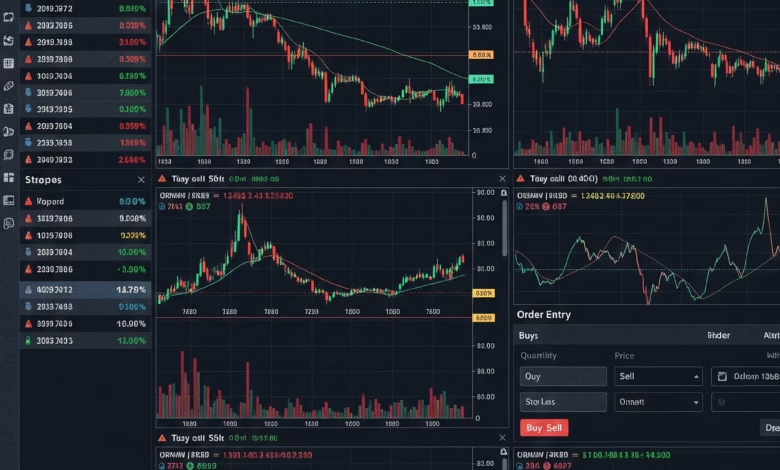
If you have ever watched a financial news channel or opened a trading app, you have seen it: the ticker tape. It is a mesmerizing stream of red and green numbers, flashing and changing faster than the human eye can track. Apple is up 0.05%. A second later, it is down 0.01%. Then up again.
For a beginner, this constant fluctuation can look like chaos. It can feel like a casino where prices are determined by random chance.
But the stock market is not a casino. It is a highly efficient, hyper-speed information processing machine. Every single tick—every fraction of a penny that a stock moves—represents a real transaction, a real decision, and a shift in the global consensus of what a company is worth.
Why does it happen every second? Why doesn’t the price just stay stable until the company releases a new product?
This guide will demystify the mechanics of the stock market. We will look under the hood to see the engines of supply and demand, the armies of algorithms, and the psychological forces that cause prices to dance every moment of the trading day.
1. The Living Auction: Understanding the Order Book
To understand why prices change, you must first understand what the “current price” actually is.
Most people think the stock price is a tag set by an official authority, like a price tag on a shirt at Walmart. This is incorrect. The stock market is an auction house, similar to eBay, but running at the speed of light.
The price you see on your screen is simply the price of the very last transaction that occurred between a buyer and a seller.
The Order Book: The Battlefield
Behind every stock symbol is a digital list called the Order Book.
-
The Bid: A list of people waiting to buy shares and the maximum price they are willing to pay.
-
The Ask: A list of people waiting to sell shares and the minimum price they are willing to accept.
Imagine a standoff.
-
Buyer A says: “I will pay $100.00.”
-
Seller B says: “I will only sell for $100.05.”
Nothing happens. The price doesn’t move. But suddenly, Buyer A gets impatient and agrees to pay $100.05. Snap. A trade happens. The “Last Price” flashes to $100.05.
Now, imagine this happening not once, but thousands of times per second, with millions of participants globally adjusting their bids and asks by pennies. That is why the price flickers constantly. It is a real-time negotiation between millions of strangers.
2. Supply and Demand: The Universal Law
The primary driver of these price changes is the most basic law of economics: Supply and Demand.
While this sounds simple, in the stock market, the balance shifts in milliseconds.
When Demand Exceeds Supply
If good news comes out about a company (e.g., they invented a cure for a disease), everyone wants to buy.
-
Buyers flood the Order Book.
-
Sellers realize they possess a hot commodity. They pull their “Ask” prices higher.
-
Buyers, desperate to get in, agree to pay the higher prices.
-
Result: The price ticks upward rapidly.
When Supply Exceeds Demand
If bad news hits (e.g., the CEO is fired), investors panic.
-
Sellers flood the market, trying to dump their shares.
-
Buyers step back, waiting for a bargain. They lower their “Bid” prices.
-
Sellers, desperate to get out, agree to sell at lower prices.
-
Result: The price crashes downward.
This tug-of-war never stops. Even on a quiet day with no news, there is always a slight imbalance between buyers and sellers, causing the price to drift up or down every second.
3. High-Frequency Trading (HFT): The Rise of the Machines

If humans were the only ones trading, stock prices might change every few minutes or hours. Humans are slow. We have to read news, think, click a mouse, and sip our coffee.
However, in modern markets, humans account for a small percentage of the daily volume. The vast majority of trading is done by Algorithms and High-Frequency Traders (HFT).
Trading at the Speed of Light
HFT firms use supercomputers located physically close to the stock exchange’s data center to execute trades in microseconds (millionths of a second).
These algorithms are programmed to spot tiny inefficiencies.
-
If an algorithm notices that Microsoft stock is trading at $300.00 on the New York Stock Exchange but $300.01 on the Nasdaq, it will instantly buy on one and sell on the other to make a penny of profit.
-
They do this millions of times a day.
Because these machines are constantly scanning, buying, and selling to capture fractions of a cent, they create a continuous stream of activity. They provide the “noise” that causes the price to twitch every single second, even when nothing fundamental has changed about the company.
4. The Flow of Information: Markets Are Efficient
There is a theory in finance called the Efficient Market Hypothesis (EMH). It states that asset prices reflect all available information.
The moment new information enters the world, the market reacts to it instantly.
What Kind of Information Moves Markets?
-
Company News: Earnings reports, product launches, mergers.
-
Economic Data: Inflation reports, unemployment numbers, GDP growth.
-
Geopolitics: Wars, elections, trade tariffs.
-
Natural Disasters: Hurricanes affecting oil refineries, droughts affecting wheat crops.
In the old days, it took time for news to travel. Today, computers scan news headlines and Twitter (X) feeds. If an algorithm reads the word “Bankruptcy” associated with a company, it can dump the stock before a human trader has even finished reading the headline. This instant reaction causes immediate, violent price swings.
5. Market Makers: The Providers of Liquidity
We mentioned earlier that for a trade to happen, a buyer must meet a seller. But what happens if you want to sell your stock and there is nobody buying right now?
Enter the Market Maker.
Market Makers are massive financial institutions (like banks or specialized firms) whose job is to ensure there is always a market. They are contractually obligated to be ready to buy and sell shares at all times.
How They Affect Price
Market Makers profit from the “Spread” (the difference between the Buy and Sell price).
-
They might buy your stock for $100.00.
-
They immediately try to sell it to someone else for $100.01.
To manage their risk, Market Makers constantly adjust their prices based on their inventory. If a Market Maker accumulates too many shares of Company X, they will lower the price to encourage people to buy them. If they are running out of shares, they will raise the price to encourage people to sell. These constant micro-adjustments contribute to the second-by-second fluctuation.
6. Macro Trends and Sector Correlation

Sometimes, a stock price changes not because of anything the company did, but because of what is happening to the “neighborhood.”
Algorithms Trade in Baskets
Institutional investors often trade entire sectors at once using ETFs (Exchange Traded Funds).
-
If the price of Oil drops, algorithms might instantly sell every energy company (Exxon, Chevron, BP, Shell) simultaneously.
-
If interest rates rise, algorithms might sell all high-growth technology stocks.
This means a company could be having a perfectly quiet day, but its stock price is jumping around because it is being dragged along by the massive currents of the global economy.
7. Fear, Greed, and Market Psychology
We cannot ignore the human element. While computers execute the trades, humans program the computers and set the strategy. Humans are emotional creatures driven by two primary forces: Fear and Greed.
The Feedback Loop
Price movement itself can cause more price movement.
-
FOMO (Fear Of Missing Out): If a stock starts rising rapidly, traders see the green numbers and jump in, terrified of missing the profit. Their buying pushes the price even higher.
-
Panic Selling: If a stock drops below a key psychological level (e.g., $100), traders get scared and sell to “stop the bleeding.” Their selling pushes the price even lower.
This psychological volatility is why stock prices often overshoot. They go higher than logic dictates during bubbles and crash lower than necessary during recessions.
8. Derivatives and Options Hedging
A hidden driver of stock prices is the Options Market.
Traders buy “Call” options (betting the price goes up) and “Put” options (betting the price goes down). The banks that sell these options have to hedge their risk.
If millions of people buy Call options on a stock, the banks (Market Makers) are forced to buy the actual stock to cover their exposure. This is known as a Gamma Squeeze.
-
As the stock price rises, banks must buy more stock.
-
This buying pushes the price up further.
-
Which forces banks to buy even more.
This mechanical hedging creates a self-fulfilling prophecy where prices move violently simply because of the mathematics of risk management.
9. Liquidity vs. Volatility: Why Some Stocks Move Faster
Not all stocks change price every second. Some small companies might not trade for hours. This is a matter of Liquidity.
-
High Liquidity (e.g., Microsoft, Amazon): Millions of shares change hands every hour. The price moves in tiny increments (pennies) constantly because the order book is thick.
-
Low Liquidity (e.g., Small Cap Penny Stock): Very few shares trade. The order book is “thin.”
In a low liquidity stock, a single large order can cause the price to jump 10% in one second because there were no sellers in between. In a high liquidity stock, a large order is absorbed easily. The frequency of price changes is a direct reflection of how active the market is.
10. The Role of Currency and Global Markets
We live in a connected world. A company listed in the US or Europe often does business in Japan, China, and Brazil.
-
If the value of the Euro changes against the Dollar, the projected profits of multinational companies change instantly.
-
Stock prices adjust in real-time to compensate for currency fluctuations.
Furthermore, markets operate 24 hours a day via “Futures” markets. If something happens in the Asian markets while the West is sleeping, the Western markets will “gap” up or down the second they open to catch up with the global reality.
The Pulse of the Economy
So, why do stock prices change every second?
It is because the world changes every second.
Every second, a product is sold, a law is passed, a currency fluctuates, a rumor is started, and an algorithm detects a pattern. The stock price is simply the financial world’s attempt to synthesize all this infinite data into a single number: The Fair Market Value.
It is messy, it is volatile, and it can be stressful to watch. But this constant movement is actually a sign of a healthy, functioning market. It means that liquidity is present, information is being processed, and buyers and sellers are finding common ground.
Key Takeaway for Investors:
Do not obsess over the second-by-second movements. This is “noise.” As a long-term investor, your focus should be on the company’s annual earnings and multi-year growth, not the chaotic dance of the ticker tape. Let the traders fight over the pennies while you wait for the dollars.