How gambling addiction can harm your financial life
Understand the impact of betting on your budget and long-term performance
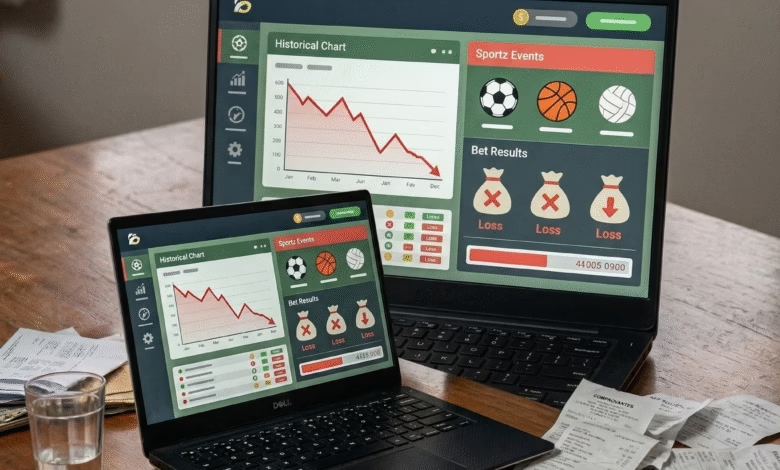
In the modern world, the local casino is no longer just a neon-lit building on the edge of town. It is in our pockets, on our television screens during every commercial break, and integrated into our favorite social media platforms. While many see a “quick bet” as a harmless form of entertainment, for a significant number of people, it evolves into a compulsive behavior that systematically dismantles their financial stability.
Gambling addiction, often called the “silent killer” of personal finance, doesn’t leave physical marks like other addictions. You can’t smell it on someone’s breath, and you can’t see it in their eyes. Usually, the first sign of trouble is a vanished savings account, a maxed-out credit card, or a sudden inability to pay for basic necessities. Understanding the intersection of neurobiology and personal finance is the first step in recognizing why this addiction is so uniquely devastating to your net worth.
The Neurochemistry of the Bet: Why the Brain Can’t Walk Away

To understand the financial ruin caused by gambling, we must first understand the “hardware” it exploits: the human brain. Gambling addiction is a behavioral disorder that hijacks the brain’s reward system, specifically the dopamine pathways.
The Dopamine Loop
When you place a bet, your brain releases dopamine—the neurotransmitter associated with pleasure and anticipation. Interestingly, the brain releases more dopamine during the uncertainty of the bet than it does during the actual win. This is why “near-misses” (when you almost win) are so addictive; the brain perceives them as a sign that a win is “coming soon,” triggering a compulsive urge to try again.
The Sunk Cost Fallacy
In finance, the sunk cost fallacy is the tendency to continue an endeavor once an investment in money, effort, or time has been made, even if the current costs outweigh the benefits. For a gambler, this manifests as “chasing losses.” The logic is: “I’ve already lost $5,000; I have to keep playing to get that money back.” This cognitive bias is the primary engine behind total financial collapse.
Hidden Financial Red Flags: Are You Betting More Than Your Money?
Identifying a gambling problem early can save hundreds of thousands of dollars. Often, the behavioral signs appear long before the total bankruptcy occurs. If you recognize these patterns in yourself or a loved one, the financial “check engine light” is flashing.
The Erosion of the Emergency Fund
The first casualty is usually the liquid savings. An emergency fund intended for car repairs or medical bills is redirected into a betting app. Because the gambler believes they are “investing” in a win, they justify using these “safety” funds as capital for their next play.
Categorizing the Behavior
| Feature | Social/Entertainment Gambling | Compulsive/Addictive Gambling |
| Budget | Fixed, pre-determined amount. | Unlimited; “chasing” losses. |
| Time Limit | Stops when the game is over. | Plays until the money is gone. |
| Reaction to Loss | Disappointment, then moves on. | Panic, urgency to “win it back.” |
| Source of Funds | Disposable income. | Savings, bills, or borrowed money. |
The Mathematical Reality: Understanding Why the House Always Wins
One of the most powerful tools against gambling addiction is a cold, hard look at the mathematics of probability. Every game in a casino or on a betting app is designed with a “House Edge.” This is a mathematical certainty that ensures the operator remains profitable over the long term.
The Law of Large Numbers
The Law of Large Numbers states that as the number of trials (bets) increases, the actual results will converge on the expected value (the house edge). You might win a single hand of blackjack or a single sports parlay, but the more you play, the closer you get to losing exactly what the house dictates.
In a fair game, the probability of an event $E$ is calculated as:
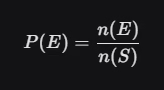
Where $n(E)$ is the number of ways the event can happen and $n(S)$ is the total number of possible outcomes.
In gambling, the “payout” never matches the true probability. For example, in American Roulette, there are 38 pockets. The true odds are 37 to 1, but the house only pays 35 to 1. This “gap” is where your wealth goes to die. Over thousands of spins, that small percentage becomes a vacuum that sucks your net worth dry.
The Debt Spiral: How Small Bets Lead to Massive Financial Crisis
The true danger of gambling addiction isn’t just losing the money you have; it is losing the money you haven’t earned yet. When personal savings are depleted, gamblers often turn to debt to fund their “recovery” (another bet).
The Progression of Credit Use
It starts with a credit card cash advance. These are particularly dangerous because they often carry much higher interest rates than standard purchases (often 25% or higher) and have no “grace period”—interest begins accruing the moment the cash is taken.
The Payday Loan Trap
When credit cards are maxed out, the next step is often high-interest payday loans. These predatory financial products can have annual percentage rates (APRs) of 400% or more. This creates a “death spiral” where the individual is taking out new loans just to pay the interest on old loans, all while still trying to “hit the big one” to solve the whole problem.
Impact on Personal Credit: The Long-Term Fallout of Compulsive Gambling
Your credit score is a reflection of your financial reliability. Gambling addiction can shatter a perfect credit score in a matter of months, with consequences that last for years.
Late Payments and Utilization
As money is diverted to gambling, essential bills—rent, utilities, car payments—go unpaid. Each 30-day late payment reported to credit bureaus can drop a score by 60 to 100 points. Additionally, maxing out credit cards increases your “Credit Utilization Ratio,” which accounts for 30% of your FICO score.
Difficulty with Future Financing
With a trashed credit score, the “hidden cost” of gambling increases.
-
Higher Interest Rates: If you eventually recover and want to buy a house, a low credit score could mean paying 2% more on a mortgage, costing you an extra $100,000+ over the life of the loan.
-
Insurance Premiums: Many insurers use credit-based insurance scores. Poor credit can lead to significantly higher auto and home insurance rates.
-
Employment Background Checks: Many employers, especially in finance or government, check credit reports. A history of financial instability can lead to job rejection.
Betting Apps and the Gamification of Financial Ruin

We are currently living through a major shift in how gambling is consumed. The “gamification” of betting apps has lowered the barriers to entry, making it easier than ever to lose significant sums of money without ever feeling like you’re “gambling.”
The “Video Game” Aesthetic
Modern apps use colorful graphics, celebratory sounds, and “achievements” to make the experience feel like a mobile game. This masks the reality that you are dealing with real currency. By using “credits” or digital chips, the app creates a psychological distance between the player and their money, making it easier to click “Bet Again” during a loss.
24/7 Accessibility and Micro-Betting
In the past, you had to wait for the game to end to see if you won. Now, “micro-betting” allows you to bet on every single play—the next pitch in a baseball game, the next point in a tennis match. This increases the frequency of the “dopamine hits,” accelerating the addiction cycle and draining bank accounts at a much faster rate.
The Crossroads of Relationships and Revenue: How Gambling Destroys Trust
Finance is rarely just about numbers; it is about relationships. Gambling addiction is often accompanied by “Financial Infidelity”—lying to a partner about the state of the household finances.
The Breakdown of the Shared Vision
When one partner is secretly gambling away the house down payment or the children’s college fund, they aren’t just stealing money; they are stealing the shared future of the couple. Discovery of the debt often leads to a total breakdown of trust, which is frequently cited as the primary reason for divorce in these cases.
The Legal Consequences
In many jurisdictions, debt incurred by one spouse during the marriage can be considered “marital debt.” This means that even if a partner had no idea about the gambling, they could be legally responsible for half of the debt in a divorce settlement. The financial impact can literally follow a non-gambling spouse for the rest of their lives.
A Blueprint for Financial Recovery: Rebuilding Your Life After Addiction

The damage of gambling addiction is severe, but it is not always permanent. Rebuilding requires a two-pronged approach: treating the behavioral addiction and implementing strict financial “firewalls.”
1. The “Clean Break” with Access
The first step is a total barrier to funds.
-
Self-Exclusion: Use state-run self-exclusion lists and software like GamBan to block access to all betting websites and physical casinos.
-
Hand over the Keys: If you are in a relationship, give your partner total control of the banking passwords and credit cards for at least a year.
-
Limit Cash: Use a debit card with a strict daily limit to prevent large cash withdrawals.
2. Debt Triage and Negotiation
Don’t ignore the collectors.
-
Credit Counseling: Contact a non-profit credit counseling agency. They can often negotiate lower interest rates and consolidate payments into a single, manageable monthly amount.
-
The “Snowball” vs. “Avalanche”: Once the gambling has stopped, use the Debt Snowball method (paying smallest balances first) to gain psychological momentum, or the Debt Avalanche (paying highest interest first) to save the most money.
3. Professional Support
Recovery from the financial ruin of gambling almost always requires professional help. Organizations like Gamblers Anonymous provide the social support needed to stay “clean,” while financial therapists can help address the underlying emotional issues that led to the behavior in the first place.
Reclaiming Your Wealth and Your Worth
Gambling addiction is a powerful force that can turn a lifetime of hard work into a mountain of debt in a matter of months. It exploits our brain’s chemistry and our natural desire for a “better life.” However, your net worth does not define your self-worth.
The road to financial recovery is long, but it is paved with small, disciplined choices. By understanding the math, recognizing the triggers, and building a support system, you can stop the invisible drain and begin to build a future based on the certainty of discipline rather than the uncertainty of luck.