For the past decade, “blockchain” has become a buzzword that dominates headlines, financial news, and tech conferences. However, for most people, the term is inextricably linked to Bitcoin and other cryptocurrencies. While it is true that Bitcoin was the first major application of this technology, confusing the two is like confusing the engine with the car.
To understand the future of finance, business, and the internet itself, we must look under the hood. What is this technology really? Why do banks, insurance companies, and supply chain giants care so much about it? And most importantly, why should you trust a system that claims to require no trust at all?
This guide breaks down the mechanics of blockchain into simple, plain English, stripping away the complex jargon to reveal the revolutionary potential of the “digital ledger.”
The Core Concept: The Digital Ledger Analogy

To understand blockchain, forget about complex algorithms for a moment. Instead, imagine a standard notebook or a ledger used by a town’s accountant.
In a traditional banking system, the bank holds the ledger. If Alice sends $50 to Bob, the bank opens its private ledger, subtracts $50 from Alice, and adds $50 to Bob. You trust the bank to keep this record accurate. You trust them not to change the numbers, not to lose the ledger, and to secure it against thieves. This is a centralized system.
Now, imagine a different system. Imagine that instead of one bank holding the ledger, everyone in the town is given an identical copy of the notebook.
When Alice wants to send $50 to Bob, she stands up and announces it to the entire town. Everyone opens their own notebook, checks to make sure Alice actually has $50, and then writes down the transaction. If a bad actor tries to sneak into one person’s house and change the numbers in their notebook to steal money, it won’t matter. The rest of the town has the correct version, and they will reject the fake record.
This is a blockchain. It is a Distributed Ledger Technology (DLT). It is a database that is shared across a computer network, ensuring that the historical record cannot be altered without the consensus of the majority.
How Does Blockchain Work? A Step-by-Step Guide
The “chain” in blockchain is not literal; it is a digital chain of data. Here is the lifecycle of a transaction on a blockchain network, simplified:
-
The Transaction Request: Someone requests a transaction. This could be sending cryptocurrency, signing a digital contract, or verifying a medical record.
-
Broadcasting: The transaction is broadcast to a peer-to-peer network consisting of computers, known as nodes.
-
Verification: The network of nodes validates the transaction and the user’s status using known algorithms. They ask: Does the sender have the funds? Is this a legitimate request?
-
Block Creation: Once verified, the transaction is combined with other recent transactions to create a new block of data. Think of this as filling up a page in the notebook.
-
Hashing (The Security Seal): This is the crucial part. The new block is given a unique digital signature called a hash. The block also contains the hash of the previous block. This links them together cryptographically.
-
Chaining: The new block is added to the existing blockchain in a way that is permanent and unalterable.
-
Completion: The transaction is complete. The ledger is updated across the entire network.
Why Is Blockchain Considered Secure and Immutable?
You will often hear the word “immutable” when discussing blockchain. In this context, immutable means “unable to be changed.”
Security in a blockchain relies on the Hash. A hash is like a digital fingerprint. If you take a piece of data (like a sentence) and run it through a hashing algorithm, you get a string of random characters. If you change even a single comma in that sentence, the hash changes completely.
Because each block contains the hash of the previous block, they are interlocked. If a hacker tries to alter a transaction that happened in Block 50, the hash for Block 50 changes. Consequently, because Block 51 holds the hash of Block 50, Block 51 changes too. Then Block 52 changes, and so on.
To successfully hack a blockchain, an attacker would need to recalculate the hashes for every subsequent block and do it for more than 50% of the computers (nodes) in the network simultaneously. For large networks like Bitcoin or Ethereum, this requires an amount of computing power that is currently physically and economically impossible.
Proof of Work vs. Proof of Stake: The Consensus Dilemma

How do all these computers agree on what is true without a manager? They use Consensus Mechanisms. These are the rules that the network follows to agree on the validity of transactions.
Proof of Work (PoW)
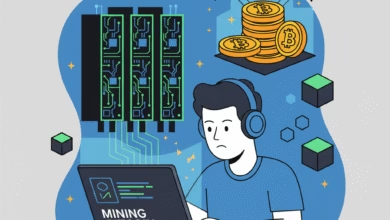
This is the mechanism used by Bitcoin. It requires computers (miners) to solve incredibly complex mathematical puzzles to validate transactions and create new blocks.
-
The Good: It is extremely secure.
-
The Bad: It consumes massive amounts of electricity and requires expensive hardware.
Proof of Stake (PoS)
This is the mechanism now used by Ethereum and many modern blockchains. Instead of using energy to solve puzzles, users “stake” (lock up) their own cryptocurrency coins to become validators. If they validate fraudulent transactions, they lose their staked coins.
-
The Good: It is energy-efficient and faster.
-
The Bad: Critics argue it can lead to centralization, where the rich (those with the most coins) have the most power.
Real-World Applications: It’s Not Just About Cryptocurrency
While cryptocurrencies are the most famous use case, the underlying technology of blockchain is disrupting industries far beyond finance.
1. Supply Chain Management
This is one of the most practical applications. Major retailers like Walmart are using blockchain to track food from the farm to the shelf.
-
The Problem: If there is an E. coli outbreak in lettuce, it used to take weeks to find the source.
-
The Solution: With blockchain, every stop the lettuce made is recorded on an immutable ledger. Retailers can trace the source of the contamination in seconds, not weeks, saving lives and reducing waste.
2. The Insurance Industry
Insurance is plagued by fraud and slow processing times. Blockchain can automate claims through Smart Contracts (more on this below). For example, flight insurance could be automated: if a flight is delayed more than two hours, the blockchain checks the official flight data and automatically triggers a refund to the customer’s wallet instantly. No paperwork, no phone calls.
3. Healthcare Records
Patient data is currently fragmented across different doctors, hospitals, and specialists. A blockchain system could provide a unified, secure medical history for a patient that is accessible by authorized doctors anywhere, while the patient retains control over the privacy keys.
4. Voting Systems
Elections are often questioned regarding their integrity. A blockchain-based voting system could allow citizens to vote digitally. Because the ledger is immutable and transparent, it would be mathematically impossible to alter votes or inject fake ballots without the network noticing.
The Rise of Smart Contracts and Decentralized Finance (DeFi)
The evolution of blockchain brought us Smart Contracts. A smart contract is a self-executing contract with the terms of the agreement between buyer and seller being directly written into lines of code.
Imagine a vending machine. You put money in, select a product, and the machine gives it to you. There is no cashier (middleman). A smart contract is a digital vending machine for complex transactions.
This technology birthed DeFi (Decentralized Finance). DeFi is a global, open alternative to every financial service you use today—savings, loans, trading, insurance—accessible to anyone in the world with a smartphone and internet connection.
-
Lending: You can lend your crypto assets to others and earn interest (often higher than traditional banks) via a smart contract, without a bank taking a cut.
-
Borrowing: You can borrow funds instantly by providing collateral, without a credit check.
What Are the Main Advantages and Disadvantages?

To understand the investment landscape, one must look at the technology objectively.
The Advantages
-
Transparency: Anyone with access to the network can view the history of transactions. This reduces fraud.
-
Security: The encrypted and distributed nature of blockchain makes it incredibly difficult to hack.
-
Efficiency: By removing intermediaries (banks, lawyers, brokers), transactions can be processed 24/7, often faster and cheaper, especially for cross-border payments.
-
Traceability: Perfect for supply chains, proving the authenticity of luxury goods, or tracking charitable donations.
The Disadvantages
-
Scalability: Some older blockchains are slow. Bitcoin, for instance, can only process a limited number of transactions per second compared to Visa.
-
Energy Consumption: Proof of Work networks use as much energy as small countries.
-
Irreversibility: If you send money to the wrong address or lose your private key (password), there is no “Forgot Password” button. The money is gone forever.
-
Regulation: The legal status of blockchain assets varies wildly by country, creating uncertainty for businesses.
Is Blockchain the Future of the Internet (Web3)?
Tech enthusiasts often refer to the next phase of the internet as Web3, and blockchain is its foundation.
-
Web1 (1990s): Read-only (static pages).
-
Web2 (2000s-Present): Read-Write (Social media, user-generated content), but controlled by massive centralized tech giants who own your data.
-
Web3 (Future): Read-Write-Own.
In a Web3 world powered by blockchain, you would own your data. You wouldn’t log in to websites with Facebook or Google; you would connect your digital wallet. If you create content, you own the tokenized rights to it. It represents a shift from centralized control to user ownership.
The Evolution is Just Beginning

Asking “What is blockchain?” today is similar to asking “What is the internet?” in 1994. At that time, people thought the internet was just for email. They couldn’t envision streaming video, social media, or remote work.
Currently, blockchain is in its infrastructure phase. It is clunky, sometimes slow, and often misunderstood. However, the core promise—a way to transfer value and data without relying on a central authority—is a fundamental shift in how the world operates.
For investors, business owners, and curious individuals, ignoring blockchain is no longer an option. Whether it transforms banking, secures our medical records, or simply changes how we buy art, the distributed ledger is here to stay. The question is not if it will impact your life, but when.