Top financial habits that are keeping you broke
Discover the financial habits that are causing you to lose money
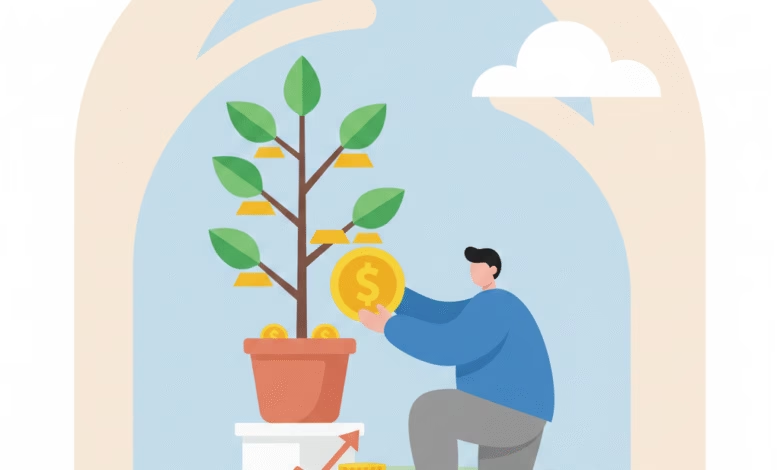
In the modern world, wealth is rarely about how much money you make; it is almost entirely about how much money you keep. There are millions of Americans earning six-figure salaries who live paycheck to paycheck, struggling to cover their monthly bills. Conversely, there are modest earners who retire as millionaires.
The difference between these two groups isn’t luck—it is habitual behavior. Most people aren’t “broke” because they don’t work hard enough; they are broke because their daily habits are designed to drain their bank accounts rather than fill them. Financial leaks are often so small that we don’t notice them until the entire ship is sinking.
If you find yourself wondering where your money goes every month, it is time to perform a “habit audit.” In this guide, we will explore the top financial habits that keep you broke and, more importantly, how to rewire your brain for long-term prosperity.
1. Falling Victim to Lifestyle Creep: The Silent Wealth Killer

Lifestyle creep (or lifestyle inflation) occurs when your standard of living increases as your income rises. You get a $5,000 raise at work, and suddenly, you feel the need for a more expensive car, a larger apartment, or more frequent dinners at high-end restaurants.
The Problem with “Deserving” It
The psychological trap of lifestyle creep is the belief that because you work hard, you “deserve” to spend more. While treating yourself isn’t inherently bad, increasing your overhead every time you increase your income keeps your savings rate at zero.
-
The Math of Creep: If you earn $50k and spend $45k, you save $5k. If you get a raise to $70k but increase your spending to $65k, you are still only saving $5k. Despite making more money, your “Time to Financial Freedom” has not changed.
-
The Solution: Implement the “50/50 Rule.” Every time you get a raise or a bonus, commit 50% of it to your future (investments/debt payoff) and allow yourself to spend the other 50%. This way, you improve your life today without sabotaging your tomorrow.
2. Relying on Credit Cards to Bridge the Monthly Gap
One of the most dangerous habits in personal finance is using a credit card as an extension of your paycheck. If you are charging groceries or utilities to a card because you don’t have the cash in your checking account, you are in a financial emergency.
The Compounding Interest Nightmare
Credit card companies thrive on the “minimum payment” habit. With average APRs hovering between 20% and 28%, carrying a balance means you are paying a massive “convenience tax” on everything you buy.
-
The Debt Cycle: When you pay interest, you have less money for next month’s expenses, which forces you to use the credit card again. This is a downward spiral that keeps you broke indefinitely.
-
The Solution: Treat your credit card like a debit card. If you don’t have the cash to pay for it immediately, don’t buy it. If you already have debt, use the “Debt Snowball” or “Debt Avalanche” method to eliminate it as fast as humanly possible.
3. The Lack of an Emergency Fund: Playing Financial Roulette
Life is unpredictable. Tires blow out, water heaters leak, and medical emergencies happen. If you don’t have a dedicated emergency fund, these inevitable events become financial catastrophes that force you to take out high-interest loans.
The Vicious Cycle of Crisis Management
Without a “buffer,” every minor inconvenience becomes a reason to go deeper into debt. This habit keeps you in a state of constant anxiety, where you are always one “bad day” away from bankruptcy.
-
The Goal: Aim for at least $1,000 as a “Starter Emergency Fund.” Once your high-interest debt is gone, build that up to 3–6 months of essential living expenses.
-
The Psychological Benefit: An emergency fund turns a “disaster” into a mere “inconvenience.” It gives you the mental clarity to make better financial decisions.
4. Emotional Spending and the “Retail Therapy” Trap
We live in a consumerist culture that tells us we can buy happiness. Emotional spending is the habit of using shopping to cope with stress, boredom, or sadness. Whether it’s a new pair of shoes or the latest tech gadget, the “dopamine hit” of a new purchase wears off quickly, leaving you with an empty wallet and the same original problem.
Identifying Your Triggers
Do you shop more when you’ve had a bad day at work? Do you find yourself scrolling through Amazon when you’re bored at night?
-
The Solution: Implement a “72-Hour Rule.” If you see something you want to buy that isn’t a necessity, wait three full days before hitting the “checkout” button. Usually, the emotional urge will pass, and you’ll realize you didn’t actually need the item.
5. Neglecting the Power of Small, Recurring Expenses

While everyone focuses on “big” purchases, it is often the small, recurring expenses that bleed a budget dry. This is known as “Death by a Thousand Cuts.”
The Subscription Economy
In the age of digital streaming, apps, and subscription boxes, it is easy to have $200–$300 a month leaving your account in small increments of $9.99 or $14.99. Because these amounts seem small, we don’t perceive them as a threat.
-
The Hidden Cost: $150 a month in unused subscriptions is $1,800 a year. Invested at a 7% return over 30 years, that money would grow to nearly $180,000.
-
The Solution: Use an app or a simple spreadsheet to audit every single recurring charge on your bank statement. If you haven’t used the service in the last 30 days, cancel it immediately.
6. Keeping Your Money in a Standard Checking Account
If you are a “saver” but you keep all your money in a traditional checking or savings account earning 0.01% interest, you are technically losing money every day.
The Inflation Tax
As we’ve discussed in previous articles, inflation erodes purchasing power. If inflation is 3% and your bank account pays 0%, your money is worth 3% less every year.
-
The Solution: Keep your “working cash” in a checking account, but move your emergency fund to a High-Yield Savings Account (HYSA). Many online banks now offer rates 400x to 500x higher than traditional brick-and-mortar banks. For your long-term wealth, ensure you are invested in assets like index funds or real estate that historically outperform inflation.
7. Comparing Your Lifestyle to “The Joneses”
Social media has amplified our natural tendency to compare ourselves to others. We see influencers and friends posting about their luxury vacations and new SUVs, and we feel a subconscious pressure to keep up.
The Illusion of Wealth
In the US, many people who look rich are actually drowning in debt. They are leasing the cars, financing the furniture, and charging the vacations. Comparing your “behind-the-scenes” (your actual bank balance) to their “highlight reel” (their curated photos) is a recipe for financial ruin.
-
The Solution: Practice “Selective Frugality.” Spend extravagantly on the things that truly bring you value, and cut costs mercilessly on things that only exist to impress other people. Real wealth is what you don’t see—it’s the balance in the brokerage account, not the logo on the handbag.
8. Not Having a Budget (or a Financial Roadmap)
If you don’t tell your money where to go, you will wonder where it went. Living without a budget is like trying to drive across the country without a GPS; you might get somewhere, but it probably won’t be where you intended.
Budgeting for People Who Hate Budgeting
You don’t need a complex accounting degree to budget. Many people find success with the 50/30/20 Rule:
-
50% for Needs (Rent, groceries, utilities).
-
30% for Wants (Dining out, hobbies, entertainment).
-
20% for Savings and Debt Repayment.
-
The Solution: Use a budgeting app like Mint, YNAB (You Need A Budget), or even a simple physical notebook. The act of tracking your spending alone is often enough to reduce unnecessary purchases by 15-20%.
9. Relying on a Single Source of Income
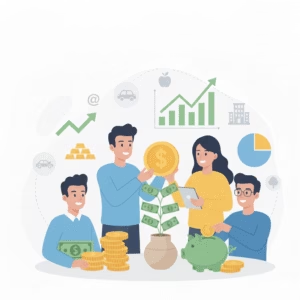
In the 1950s, a single income from a “loyal” company was enough to sustain a family for life. In 2026, relying on a single paycheck is one of the riskiest financial habits you can have.
The Fragility of the W-2
If your boss decides to downsize or your industry is disrupted by AI, your income drops to zero overnight. Broke people often focus only on “saving,” whereas wealthy people focus on “diversifying.”
-
The Solution: Start building a secondary income stream. This doesn’t have to be a full-time business. It could be dividend-paying stocks, a rental property, a side hustle, or selling digital products. Multiple streams of income provide the “anti-fragility” needed to survive economic downturns.
10. Neglecting Financial Education and “Expert” Advice
Many people remain broke because they find finance “boring” or “intimidating.” They outsource their financial decisions to predatory “advisors” who charge high commissions, or they simply ignore their finances altogether, hoping things will work out.
The Cost of Ignorance
The difference between a 1% fee and a 0.05% fee on an investment portfolio can mean a difference of hundreds of thousands of dollars by the time you retire. If you don’t understand the basics of taxes, interest, and investing, you are essentially leaving your front door unlocked.
-
The Solution: Dedicate just 30 minutes a week to financial education. Read a blog post, listen to a finance podcast, or read one of the top financial books we’ve recommended. You don’t need to be an expert, but you must be the “CEO” of your own money.
11. The Path from “Broke” to “Building”
Being “broke” is often a temporary state, but “poor” is a mindset. The habits listed above are common, but they are not mandatory. By identifying which of these traps you’ve fallen into, you’ve already taken the hardest step: awareness.
Financial freedom is built on a series of boring, consistent, and disciplined choices. It’s about choosing your future self over your current impulse. Start today by picking just one habit to change. Whether it’s canceling one subscription, opening a high-yield savings account, or finally starting that budget, the momentum of that one choice will eventually lead to a lifetime of security.