How stock exchanges connect buyers and sellers
Have you ever stopped to think about how the stock market connects buyers with sellers?
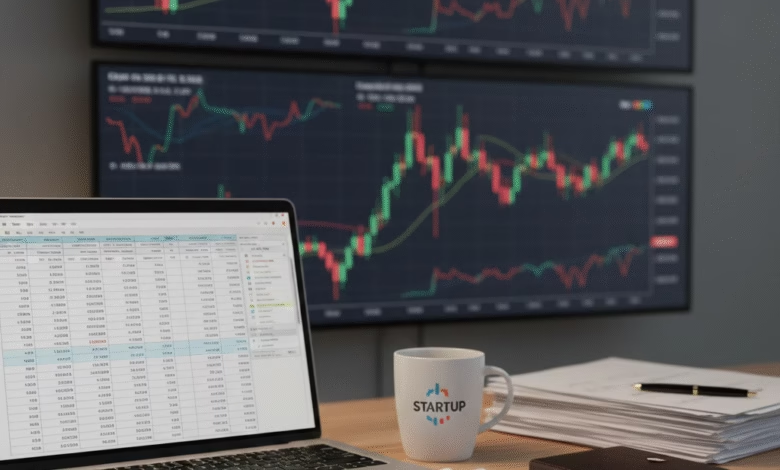
When you press “Buy” on your investment app, you likely envision a seamless, instant transaction. You want shares of a company, and moments later, you have them. But have you ever stopped to consider the technological marvel that makes this possible?
How does your desire to buy 10 shares of a tech company in London or New York instantly find a stranger willing to sell exactly 10 shares at that exact price?
The stock exchange is often described as the heartbeat of the global economy, but it is effectively a massive, high-speed matchmaking service. It is a digital arena where millions of participants—from day traders in their pajamas to massive pension funds managing billions—converge to agree on a price.
This guide will demystify the complex machinery behind the stock market. We will move beyond the Hollywood image of shouting traders on a floor and look inside the silent, fiber-optic networks that actually connect the world’s capital.
The Evolution: From Coffee Houses to Supercomputers

To understand how the connection works today, we must look at how it started.
Centuries ago, if you wanted to sell a share in a shipping company, you had to physically walk to a coffee house (like Lloyd’s of London or the Tontine Coffee House in New York). You would write your offer on a chalkboard or shout it out. A buyer would have to be in the same room, at the same time, to hear you.
The Modern Reality:
Today, the “room” is virtual. The “chalkboard” is an electronic Order Book. And the “shout” travels at the speed of light.
Modern stock exchanges (like the NYSE, Nasdaq, LSE, or Tokyo Stock Exchange) are essentially massive data centers. Their primary job is not to set prices, but to provide the infrastructure where buyers and sellers can find each other efficiently, transparently, and safely.
1. The Gatekeepers: Why You Can’t Walk onto the Exchange
The first thing to understand is that you are not directly connected to the exchange.
Stock exchanges are exclusive clubs. Only “Members”—typically large banks and brokerage firms—have direct access to the exchange’s computer systems.
The Chain of Connection
-
The Investor (You): You enter an order on your phone or computer.
-
The Broker: Your app (the broker) receives your order. They perform risk checks to ensure you have the money.
-
The Fix Protocol: The broker converts your request into a standard financial language called FIX (Financial Information eXchange).
-
The Exchange: The broker transmits this digital message to the exchange’s servers.
This entire relay race happens in milliseconds. The broker acts as your authorized representative, carrying your “vote” on price into the central arena.
2. The Order Book: The Central Nervous System
Once your order reaches the exchange, it doesn’t just float around randomly. It is organized into the Central Limit Order Book (CLOB).
This is the core mechanism of connection. Imagine a massive digital ledger that is split into two columns:
The Bid (The Buyers)
On the left side is a list of everyone who wants to buy. It is sorted by price, from highest to lowest.
-
Buyer A: Wants to pay $100.05
-
Buyer B: Wants to pay $100.04
-
Buyer C: Wants to pay $100.00
The Ask (The Sellers)
On the right side is a list of everyone who wants to sell. It is sorted by price, from lowest to highest.
-
Seller X: Wants to sell for $100.06
-
Seller Y: Wants to sell for $100.08
-
Seller Z: Wants to sell for $100.10
The Spread
The gap between the highest buyer ($100.05) and the lowest seller ($100.06) is called the Bid-Ask Spread. In this example, the spread is 1 cent. The exchange’s job is to close this gap.
3. The Matching Engine: The Algorithm That makes the Deal

This is where the magic happens. The exchange runs a powerful piece of software called the Matching Engine.
The engine constantly scans the Order Book. It looks for the moment when a Buyer’s price meets or exceeds a Seller’s price.
The Rules of the Match
Exchanges typically use a “Price/Time Priority” algorithm to decide who gets connected first.
-
Price is King: The buyer willing to pay the most and the seller willing to accept the least are always front of the line.
-
Time is Tie-Breaker: If two buyers both want to pay $100.05, the one who placed the order first gets the shares.
Example of a Connection:
If you enter a “Market Order” to buy, you are telling the engine: “I accept the lowest seller’s price immediately.”
The engine instantly grabs the shares from Seller X at $100.06 and transfers them to you. The connection is made, the trade is executed, and the ticker tape updates the “Last Price” to $100.06.
4. Market Makers: What If No One Is There?
Imagine you want to sell a stock, but the Order Book is empty. There are no buyers. Does your order just sit there?
In a liquid market, this rarely happens because of a special participant called a Designated Market Maker (DMM) or Specialist.
These are massive financial firms (like Citadel Securities or Virtu Financial) that have a contract with the exchange. They are obligated to always provide a connection.
-
Their Job: They must always have a “Buy” order and a “Sell” order listed on the books.
-
The Connection: If there are no natural buyers (like other humans), the Market Maker will step in and buy your shares. They act as the “Buyer of Last Resort” to ensure the market keeps moving.
Without Market Makers, the connection between buyers and sellers would be broken during times of panic, causing the market to freeze.
5. Liquidity: The Ease of Connection
When financial analysts talk about “Liquidity,” they are talking about how easy it is to connect a buyer with a seller without changing the price drastically.
-
High Liquidity (e.g., Apple, Microsoft): There are millions of buyers and sellers. You can buy $1 million worth of stock instantly, and the price won’t move. The connection is seamless.
-
Low Liquidity (e.g., A small penny stock): There might only be five people trading today. If you want to sell, you might have to lower your price significantly to entice a buyer. The connection is difficult (Illiquid).
The stock exchange incentivizes liquidity by offering lower fees to traders who place “Limit Orders” (adding to the book) rather than “Market Orders” (taking from the book).
6. Dark Pools: The Hidden Connections

Not all connections happen on the public stock exchange (lit market).
Institutional investors (like Mutual Funds or Pension Plans) often need to trade massive blocks of stock—say, 1 million shares. If they put that order on the public NYSE order book, the market would panic, and the price would skyrocket before they could finish buying.
To avoid this, they use Dark Pools.
These are private exchanges where the Order Book is not visible to the public. The matching engine connects a massive buyer with a massive seller secretly. The trade is only reported to the public after it is finished. While this sounds shadowy, it is a necessary mechanism to allow large institutions to connect without destabilizing the market for retail investors.
7. High-Frequency Trading (HFT): Speed as a Connector
In the modern era, the entities connecting buyers and sellers are often algorithms, not humans.
High-Frequency Traders (HFT) use supercomputers located physically close to the exchange’s data center to trade in microseconds.
How HFT Connects the Market
HFT firms often practice “Arbitrage.”
-
They see a buyer on Exchange A willing to pay $10.01.
-
They see a seller on Exchange B selling for $10.00.
-
The HFT computer buys from B and sells to A in less than the blink of an eye.
While controversial, HFT firms argue that they “tighten the spread,” making the connection cheaper and more efficient for the average retail investor.
8. Clearing and Settlement: The Final Handshake
The “Connection” on the stock exchange is only the agreement. It is the handshake. But the exchange of the actual goods (cash and shares) happens later.
This process is handled by a Clearing House (like the DTCC in the US).
-
The Trade: You and the seller agree on a price at 10:00 AM on Monday.
-
The Clearing: The Clearing House steps in the middle. It becomes the buyer to the seller, and the seller to the buyer. This removes the risk that the stranger you traded with runs away with your money.
-
Settlement (T+1): By Tuesday (Trade Date + 1 business day), the Clearing House officially moves the digital ownership title to your broker and moves the cash to the seller’s broker.
The stock exchange facilitates the agreement, but the Clearing House facilitates the delivery.
9. Price Discovery: The Result of the Connection
The ultimate purpose of connecting millions of buyers and sellers is Price Discovery.
No single person knows what a company is worth. Is Tesla worth $100 or $1,000?
-
The Optimists (Buyers) push the price up.
-
The Pessimists (Sellers) push the price down.
The “Market Price” is simply the equilibrium point where these two forces connect. By bringing everyone to a central gathering place, the stock exchange ensures that the price you see on your screen is the most accurate reflection of the world’s collective opinion at that very second.
A Miracle of Engineering

The next time you look at a stock chart, try not to see just a wiggly line. Try to visualize the millions of connections happening beneath the surface.
The stock exchange is a technological marvel that allows a dentist in Brazil to sell shares to a teacher in Japan, mediated by a server in New Jersey, with a Market Maker in Chicago ensuring the trade happens instantly.
It is a system built on trust, speed, and complex rules, all designed to answer a simple question: “What is this worth?” and “Who wants to buy it?”
By understanding these mechanics, you move from being a passive gambler to an informed participant in the world’s greatest marketplace.