Loans
60-Month vs. 72-Month Car Loans: Which Is Better?
Compare 60-month and 72-month car loans and understand how each term affects monthly payments and total interest
Buying a new or pre-owned vehicle is one of the most significant financial commitments you will make outside of purchasing a home. For most buyers, financing is an inevitable part of the journey. As vehicle prices continue to rise, traditional financing terms like 36 or 48 months have largely been overshadowed by longer terms. Today, stepping onto a dealership lot or browsing online inventories almost always introduces you to extended financing options, most notably 60-month and 72-month car loans.
Choosing the right auto loan term is a critical financial decision. While a longer loan term can make your dream car feel more affordable month-to-month, it often hides substantial long-term costs. Conversely, a shorter term requires a higher monthly commitment but saves you thousands in interest charges.
This comprehensive guide analyzes the differences between 60-month and 72-month car loans, breaking down the financial implications, total interest paid, vehicle depreciation, budgeting impacts, and long-term ownership strategies to help you determine which option aligns best with your financial goals.
Understanding Auto Loan Basics: How Loan Terms Shape Your Financial Commitment

Before diving into the direct comparison between a 60-month loan (five years) and a 72-month loan (six years), it is essential to understand the mechanics of auto financing. An auto loan consists of three primary components: the principal amount borrowed, the interest rate (Annual Percentage Rate or APR), and the loan term.
When you extend your loan term, you spread the principal balance across a larger number of monthly payments. For example, if you finance thirty thousand dollars at a five percent interest rate:
-
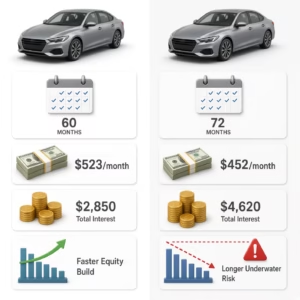
A 60-month loan results in a monthly payment of approximately five hundred and sixty-six dollars.
-
A 72-month loan reduces your monthly payment to approximately four hundred and eighty-three dollars.
At first glance, the seventy-two-month option appears advantageous because it frees up eighty-three dollars each month in your budget. However, this immediate monthly relief comes with hidden financial trade-offs that compound over time. Understanding how interest accrues on these loans is the first step toward making an informed decision.
Upfront Savings vs. Long-Term Costs: The Mathematics of Interest Accrual
The primary battleground between a 60-month loan and a 72-month loan lies in the total cost of borrowing. Interest is charged on the remaining principal balance of your loan each month. The longer you take to pay off that principal, the more interest cycles through the life of the loan.
Using our previous example of borrowing thirty thousand dollars at a five percent fixed APR:
-
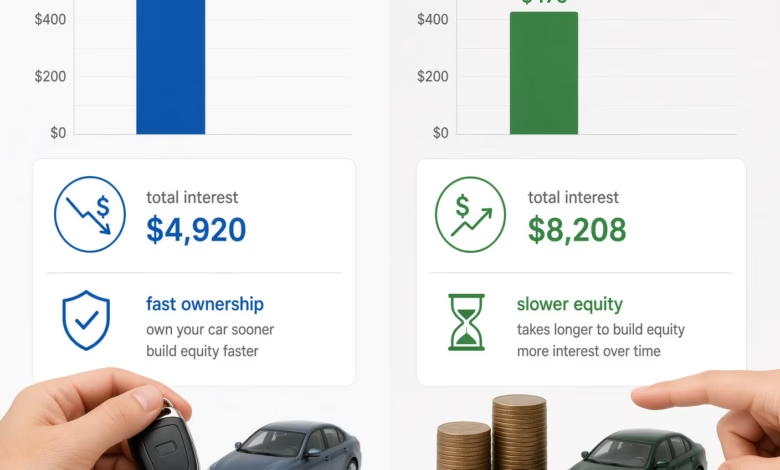
Over 60 months, you will pay a total of approximately three thousand nine hundred and eighty dollars in cumulative interest.
-
Over 72 months, your total interest climbs to approximately four thousand seven hundred and ninety dollars.
While an extra eight hundred dollars in interest over six years might not sound catastrophic, real-world scenarios often involve higher interest rates, particularly for buyers with average or below-average credit scores. If your APR is eight percent on a thirty-thousand-dollar balance:
-
The 60-month loan accrues roughly six thousand six hundred dollars in interest.
-
The 72-month loan accrues roughly eight thousand one hundred dollars in interest—a difference of fifteen hundred dollars simply for stretching out the payments by one year.
Extended terms effectively make the vehicle significantly more expensive than its sticker price. When evaluating these options, you must weigh the monthly cash flow relief against the guaranteed increase in the total price of the vehicle.
Monthly Budgeting and Cash Flow Management: Finding Your Comfort Zone
For many households, monthly cash flow dictates financial decisions. Fixed expenses like housing, utilities, groceries, and insurance leave a finite amount of disposable income for transportation. This is where 72-month loans gain their immense popularity among consumers.
A lower monthly payment provides a psychological safety net. It reduces the risk of default during unexpected financial emergencies, such as medical bills or temporary employment disruptions. If your budget is tight, a 72-month loan can prevent you from becoming “car poor”—a situation where your vehicle payment consumes an unsustainable portion of your monthly income.
However, financial experts generally recommend keeping your total vehicle expenses (including loan payments, insurance, fuel, and maintenance) below fifteen to twenty percent of your take-home pay. If a 60-month loan pushes your debt-to-income ratio past a comfortable threshold, it indicates that you may be looking at a vehicle that exceeds your realistic purchasing power. Rather than extending the loan term to 72 months to make the math work, a safer alternative is often choosing a less expensive vehicle or making a larger down payment.
Vehicle Depreciation and the Dangers of Negative Equity
One of the most critical yet frequently overlooked aspects of long-term auto financing is the relationship between the loan amortization schedule and vehicle depreciation.
Vehicles begin losing value the moment they are driven off the dealership lot. A new car typically depreciates by twenty percent within the first year and can lose up to forty to fifty percent of its value by the end of three years. Depreciation occurs much faster than the rate at which you pay down the principal balance on a long-term loan.
When your loan balance exceeds the actual market value of your car, you are in a state of negative equity, commonly referred to as being “upside down” on your loan.
-
60-Month Loan: The accelerated principal reduction helps you build equity faster. By year three or four, the loan balance is much closer to the vehicle’s trade-in value.
-
72-Month Loan: Because the monthly payments allocate a smaller fraction toward the principal during the early years, you remain upside down for a much longer portion of the ownership lifecycle.
Negative equity poses severe risks under specific circumstances:
-
Totaled or Stolen Vehicles: If your car is involved in an accident and declared a total loss, your auto insurance payout will only cover the current market value of the vehicle, not your remaining loan balance. If you are deeply upside down on a 72-month loan, you will have to pay out-of-pocket to cover the difference between the insurance payout and your loan payoff amount.
-
Trade-In Traps: If you prefer upgrading your vehicle every few years, negative equity rolls over into your next loan. This creates a dangerous debt snowball, where you finance a new car plus the remaining balance of your old car, making future financial recovery even harder.
Credit Score and Interest Rate Impact on Loan Duration
Your credit score acts as the gatekeeper to your interest rate, and your interest rate heavily influences whether a 60-month or 72-month loan makes mathematical sense.
Lenders view longer loan terms as higher risk. Because a lot can change in a person’s financial life over six years compared to five years, lenders often tack on a higher interest rate for 72-month loans. A buyer might qualify for a 4.5 percent APR on a 60-month term, but the same lender might quote 5.5 percent or higher for a 72-month term on the exact same vehicle.
When you combine a higher interest rate with an extended duration, the cost multiplier accelerates rapidly.
-
Excellent Credit (740+): Buyers with pristine credit can often secure promotional rates (such as zero percent or 1.9 percent financing) for 60 months, but these low rates are rarely available for 72-month terms. When zero percent financing is on the table, a longer loan term carries virtually no interest penalty, making the longer term a logical choice for maximizing liquidity.
-
Fair to Good Credit (580–739): Borrowers in this range face standard market rates. Choosing a 72-month loan while carrying a higher interest rate means you are paying a heavy premium for comfort. In these instances, a 60-month loan paired with a slightly more affordable vehicle is almost always the wiser financial path.
The True Cost of Ownership: Maintenance, Warranties, and Repairs
Cars require maintenance, and older vehicles require more frequent and expensive repairs. When you commit to a 72-month loan, you are financing a vehicle for six full years of wear and tear.
Consider how warranty coverage intersects with your loan term:
-
Most standard factory bumper-to-bumper warranties last for three years or thirty-six thousand miles.
-
Powertrain warranties typically cover five years or sixty thousand miles.
On a 60-month loan, you will likely pay off the vehicle right around the time major mechanical components exit their warranty coverage. On a 72-month loan, you enter your sixth year of ownership completely unprotected by factory warranties. During this final year, you could find yourself simultaneously making a high monthly car payment and paying out-of-pocket for transmission repairs, brake replacements, or electrical diagnostics.
Combining a car payment with heavy maintenance expenses puts immense strain on household cash flow, reinforcing the value of retiring your debt as quickly as your budget allows.
Behavioral Economics: Why We Choose Longer Terms (And How to Resist)
Human psychology plays a massive role in auto financing. Dealership sales professionals are trained to focus the conversation on the monthly payment rather than the “out-the-door” price of the vehicle.
When a salesperson asks, “What kind of monthly payment are you looking for?” they are opening the door to extended loan terms. By stretching the term from 60 to 72 or even 84 months, a dealership can sell you a more expensive vehicle, a higher trim level, or expensive add-on packages (like extended service contracts, gap insurance, and paint protection) without significantly altering your monthly budget target.
Falling into this trap means you end up paying significantly more for features and accessories that lose their novelty quickly. To combat this psychological bias, shift your negotiation framework:
-
Negotiate the Total Price First: Agree upon the final purchase price of the vehicle independently of financing discussions.
-
Shop Around for Financing: Secure pre-approval from a credit union or online bank before visiting a dealership. This establishes a baseline interest rate and loan term that gives you leverage.
-
Focus on the Out-the-Door Number: Always calculate the total cumulative cost of the loan before signing the paperwork.
Nailed It or Missed It? Evaluating Flexible Alternatives to Traditional Loans
If you find yourself torn between the tight budget of a 60-month loan and the comfortable payments of a 72-month loan, consider exploring alternative strategies that bridge the gap without the drawbacks of extended financing.
1. The 60-Month Loan with Extra Principal Payments
You can achieve the best of both worlds by choosing a 60-month loan to secure a lower interest rate, but budgeting your monthly outflows as if you had a 72-month loan. On months when cash flow is tight, you pay the required 60-month minimum. On months with extra cash flow, you make additional principal-only payments. This gives you the flexibility of a lower required payment while retaining the interest-saving benefits of a shorter loan structure.
2. Increasing the Down Payment
Often, the desire for a 72-month loan stems from a shortfall in the initial down payment. Increasing your down payment by just two or three thousand dollars can drop the financed principal enough to make a 60-month payment fit comfortably within your monthly target without extending your timeline.
3. Adjusting the Vehicle Price Point
If the math only works by stretching a loan to 72 or 84 months, it is a clear market signal that the vehicle is outside your current financial comfort zone. Stepping down a trim level, considering a certified pre-owned vehicle with lower depreciation risk, or exploring reliable economy brands can eliminate the need for extended financing entirely.
Making Your Decision: When to Choose 60 Months vs. 72 Months

To summarize your options clearly, evaluate your personal financial profile against these guidelines:
-
Choose a 60-Month Loan If:
-
You want to minimize total interest paid over the life of the loan.
-
You prefer building equity quickly to avoid prolonged negative equity.
-
You plan to keep the vehicle for many years after the loan is paid off.
-
Your monthly budget comfortably absorbs the slightly higher payment without straining your emergency savings.
-
-
Choose a 72-Month Loan If:
-
You secured a promotional low APR (such as zero percent financing) where stretching the term carries no financial penalty.
-
Your cash flow requires absolute protection against unexpected emergencies, and you have no alternative vehicle choices.
-
You treat the loan as a safety net but actively plan to make extra principal payments whenever financial conditions permit.
-
Ultimately, your auto loan should serve your financial well-being, not trap you in a cycle of long-term debt and rapid depreciation. By carefully analyzing your budget, prioritizing total ownership costs over monthly payments, and matching your loan term to your long-term goals, you can drive away with confidence knowing you made the smartest financial choice for your future.