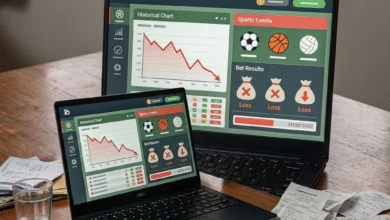
Greed and fear: the two greatest enemies of the investor
Understand how fear and greed can influence your decisions and harm your investments

The financial markets are often portrayed as hyper-rational ecosystems governed by supercomputers, complex mathematical algorithms, and sophisticated quantitative models. Yet, beneath the surface of ticker symbols, real-time charts, and economic indicators lies an entirely different engine: human psychology.
Throughout history, individual wealth has rarely been destroyed by a lack of access to financial information or technical tools. Instead, the greatest threat to an investor’s long-term prosperity is almost always found in the mirror.
At the center of behavioral finance are two primal emotions that have governed human decision-making for millennia: greed and fear. When left unchecked, these emotional forces compel rational individuals to buy assets at astronomical tops, sell holdings at painful bottoms, take on catastrophic risk, and abandon carefully crafted financial plans.
To build lasting wealth, achieve financial independence, and navigate the volatile landscape of global markets, mastering these two psychological forces is not optional—it is the foundational requirement of successful investing.
Understanding the Behavioral Science of Wealth Management

Traditional economic theory rests on the assumption that human beings are rational actors who process all available information objectively to maximize their personal utility. However, the modern field of behavioral economics has repeatedly proven that real-world investors rarely act with pure logic.
When money is on the line, the human brain relies on mental shortcuts known as heuristics. While these cognitive shortcuts helped early humans survive physical threats in nature, they often lead to financial disaster in modern capital markets.
- Confirmation Bias: The tendency to seek out news and analysis that confirm existing opinions while ignoring warning signs that contradict them.
- Recency Bias: The assumption that whatever the market is doing right now—whether surging upward or plummeting downward—is what it will continue to do indefinitely.
- The Illusion of Control: Believing that trading frequency, intense research, or emotional investment can influence the broader movement of asset prices.
These biases act as fuel for greed and fear. Understanding that your brain is naturally hardwired to make irrational emotional choices during times of financial stress is the first step toward building a bulletproof investment strategy.
The Anatomy of Greed: Why High-Yield Temptations Ruin Portfolios
Greed in financial markets is subtle. It rarely looks like overt villainy; instead, it disguises itself as ambition, financial savvy, and opportunistic genius. Greed promises rapid wealth accumulation, tempting investors to shortcut the slow, compounding process that true financial growth requires.
When market prices trend upward for extended periods, greed distorts risk perception. High returns create a psychological environment where risk is no longer viewed as potential loss, but rather as an unnecessary obstacle standing between an investor and easy profits.
       [ EUPHORIA ]  <-- Peak Greed: Maximum Financial Risk
      /            \
 [THRILL]        [ANXIETY]
    /                \
[OPTIMISM]          [PANIC]
  /                    \
[HOPE]              [DESPAIR] <-- Peak Fear: Maximum Financial Opportunity
The Anatomy of FOMO (Fear of Missing Out)
Ironically, one of the primary drivers of financial greed is a specific form of fear: the fear of missing out. Watching neighbors, coworkers, or internet personalities generate massive paper gains on speculative assets creates acute psychological discomfort. Investors begin to feel that remaining disciplined is equivalent to falling behind.
FOMO forces investors to abandon their strategic asset allocation and chase parabolic price charts. By entering asset classes at peak valuations, they absorb maximum risk for minimum upside potential.
Excessive Leverage and Margin Hazards
Greed frequently convinces investors that their normal rate of return is insufficient. To accelerate gains, individuals turn to borrowed capital, financial leverage, or margin trading. While leverage amplifies gains during a rising market, it works with devastating symmetry on the downside. A minor market correction that an unleveraged investor could easily endure can completely wipe out a leveraged portfolio through margin calls and forced liquidation.
Yield Chasing and Narrative Fallacies
In low-interest environments or stagnant markets, greed manifests as “yield chasing.” Investors migrate away from secure, fundamental investments toward exotic financial instruments promising unsustainably high yields or guaranteed returns. To justify these choices, investors rely on narrative fallacies—compelling stories about groundbreaking technologies or new paradigms that claim traditional valuation metrics no longer apply.
The Mechanics of Fear: How Panic and Loss Aversion Destroy Compounding
If greed is the force that lures investors off the cliff, fear is the force that pushes them off once volatility hits. Fear is a defensive mechanism, hardwired into human neurobiology to preserve survival when a threat is detected. However, in personal finance, reacting instinctively to perceived financial danger almost always converts temporary paper losses into permanent capital destruction.
Loss Aversion Theory
Pioneered by psychologists Daniel Kahneman and Amos Tversky, Prospect Theory demonstrates that human beings experience the psychological pain of a loss roughly twice as intensely as the pleasure derived from an equivalent gain. Losing $10,000 causes far more emotional anguish than winning $10,000 causes joy.
Because loss aversion is so deeply ingrained, market downturns trigger intense survival instincts. Investors become desperate to make the pain stop, leading them to liquidate assets at the worst possible moments—effectively locking in catastrophic losses at market bottoms.
The Panic Selling Trap
When economic headlines turn grim and stock tickers show red across the board, panic sets in. Panic selling is an emotional release valve. Liquidating a portfolio brings immediate psychological relief because it eliminates short-term volatility.
However, this short-term relief carries a permanent financial cost:
- Capital Realization: It transforms temporary market fluctuations into permanent, unrecoverable losses.
- Missing Recovery Rallies: Historically, the best market days often occur in close proximity to the worst market days. Missing just a handful of the strongest recovery days drastically reduces long-term portfolio growth.
- Re-entry Paralysis: Investors who sell in a panic rarely know when to re-enter. They often wait until the market has fully recovered and prices are high again, systematically executing a strategy of buying high and selling low.
The Cash Hoarding Fallacy
Fear does not only strike during market crashes; it also manifests as long-term cash hoarding. Investors who are perpetually terrified of impending economic collapse keep their savings in low-yielding cash accounts. While cash provides emotional safety, it exposes capital to the quiet, guaranteed erosion of purchasing power caused by inflation. Over long horizons, sitting entirely in cash can be as damaging to wealth accumulation as reckless speculation.
The Market Cycle of Emotions: Mapping the Investor Rollercoaster
Financial markets do not move in straight lines; they operate in cycles driven by human psychology. The psychological trajectory of a market cycle follows a predictable sequence of emotional milestones.
+-------------------------------------------------------------------------+
|                    THE EMOTIONAL MARKET CYCLE                           |
|                                                                         |
|        (Greed Peak)                                                     |
|          Euphoria                                                       |
|        /          \                                                     |
|    Thrilled        Anxiety                                              |
|      /                \                                                 |
|  Optimistic            Denial                                           |
|    /                      \                                             |
| Hopeful                    Panic                                        |
|   /                          \                                          |
| Base                          Capitulation                              |
|                                  \                                      |
|                                   Despair (Fear Trough)                 |
+-------------------------------------------------------------------------+
Stage 1: The Bull Phase (Optimism to Euphoria)
- Optimism: The market begins to rise following a slump. Investors show cautious interest, supported by improving economic fundamentals.
- Thrill: As returns materialize, confidence surges. Success stories spread, and investors increase their capital allocations.
- Euphoria: The absolute peak of market greed. Valuation metrics are dismissed. Price increases are taken for granted, and retail participation reaches record highs. Risk is perceived as non-existent.
Stage 2: The Bear Phase (Anxiety to Despair)
- Anxiety: The market experiences its first sharp correction. Investors dismiss it as a temporary dip, assuming high growth will resume immediately.
- Denial: Prices continue to trend downward. Investors refuse to acknowledge fundamental shifts, holding onto deteriorating positions to avoid taking losses.
- Panic: The decline accelerates. Headlines grow alarming, and fear takes control. Investors realize their capital is rapidly diminishing.
- Capitulation: The breaking point. Overwhelmed by the pain of loss, investors sell en masse regardless of asset quality, seeking only to preserve whatever cash remains.
- Despair: The absolute bottom of the market cycle. Public interest in investing vanishes, sentiment is overwhelmingly negative, and assets trade at deep discounts. Ironically, this point of maximum emotional pain represents the point of maximum financial opportunity.
Historical Lessons: When Mass Emotions Drove Economic Bubbles

The dynamic between greed and fear is not a recent phenomenon born from modern electronic trading. It is an enduring characteristic of human nature, demonstrated repeatedly across centuries of economic history.
The Dutch Tulip Mania (1637)
In 17th-century Holland, single rare tulip bulbs traded for prices exceeding the cost of a luxury home. Greed convinced citizens from every economic background that tulip prices would rise indefinitely. When panic eventually struck, the market collapsed overnight, leaving speculative buyers holding worthless botanicals and causing widespread economic dislocation.
The South Sea Bubble (1720)
The South Sea Company was granted a monopoly on trade with South America. As rumors of unimaginable wealth spread throughout Britain, speculative greed drove stock prices up tenfold in less than a year. Even Sir Isaac Newton succumbed to the mania, losing a vast portion of his life savings when the bubble burst. His legendary observation perfectly encapsulates the conflict: “I can calculate the motion of heavenly bodies, but not the madness of people.”
The Dot-Com Boom and Bust (1995–2002)
The rise of the commercial internet triggered an unprecedented wave of speculative greed in the late 1990s. Investors poured billions into any company ending in “.com,” regardless of whether the business possessed earnings, revenue, or a viable business model.
When valuations unraveled in 2000, panic selling wiped out trillions of dollars in market capitalization, driving the NASDAQ down roughly 78% before the market finally stabilized.
The 2008 Great Financial Crisis
A toxic mix of unchecked financial greed and complex credit instruments led to systemic risks across global banking systems. When the subprime mortgage market unraveled, systemic greed inverted instantly into systemic panic. Liquidity froze, credit markets seized, and global equity markets experienced dramatic drawdowns, leaving unprepared investors financially devastated.
The Neuroscience of Investing: Dopamine, Cortisol, and Financial Choices
To master market emotions, it is helpful to understand what happens physically inside the human brain during periods of financial stress and opportunity. Financial decisions are heavily influenced by biological reactions managed by neurotransmitters and hormones.
| Brain Chemical | Primary Trigger in Investing | Behavioral Impact |
|---|---|---|
| Dopamine | Anticipation of financial gain, stock price surging, successful trades | Induces pleasure, encourages risk-taking, fosters overconfidence, drives FOMO |
| Cortisol | Sudden portfolio drawdowns, market volatility, financial bad news | Triggers fight-or-flight response, impairs long-term thinking, compels panic selling |
| Adrenaline | Fast market moves, leverage trading, liquidations | Heights short-term stress, forces reactive decision-making |
When a portfolio experiences a surge in value, the brain’s reward centers release dopamine. This is the exact same chemical mechanism involved in addiction. Dopamine creates a feeling of euphoria and compels the individual to repeat the action that caused the reward—leading investors to buy more of an overextended asset.
Conversely, when markets crash and account values drop, the amygdala activates the body’s threat-response system, releasing cortisol and adrenaline. Cortisol shuts down long-term strategic reasoning in favor of immediate self-preservation. In ancient environments, running away from a physical predator was a life-saving response; in modern stock markets, running away from market dips by selling destroys capital.
Recognizing that emotional urges during market swings are biological responses helps investors separate physical sensations from strategic, logical action.
Creating an Investment Policy Statement to Eliminate Emotional Trading
The most effective way to eliminate greed and fear from investment execution is to make all critical financial decisions before emotions enter the picture. Institutional investors do this by utilizing a written Investment Policy Statement (IPS).
An IPS serves as a personal financial constitution—a binding contract made by your rational self to govern your behavior when your emotional self is tempted to act foolishly.
Essential Components of an Effective IPS
+-------------------------------------------------------------------+
|                  INVESTMENT POLICY STATEMENT (IPS)                |
|                                                                   |
|  1. Core Objectives & Horizon  --> Defines long-term targets      |
|  2. Target Asset Allocation    --> Sets fixed portfolio balance   |
|  3. Systematic Rebalancing     --> Mandates buying low/selling high |
|  4. Emergency Reserves         --> Shields investments from panic |
|  5. Defined Contributions      --> Automates ongoing growth       |
+-------------------------------------------------------------------+
1. Core Financial Objectives and Time Horizon
Document explicitly what the money is being invested for (e.g., retirement in 25 years, purchasing a home in 10 years, or building a multi-generational legacy). Clearly defined timelines contextualize short-term market noise. A 20% drawdown in a single year matters far less if the capital is intended to grow undisturbed for three decades.
2. Target Asset Allocation
Define the exact percentage of your portfolio allocated across different asset classes, such as:
- Global Equities (Broad-market index funds)
- Fixed Income (Government and corporate bonds)
- Cash and Cash Equivalents
- Real Estate or Alternative Investments
An explicit baseline prevents you from wildly shifting your portfolio into speculative assets during bull markets or abandoning equities during bear markets.
3. Systematic Rebalancing Rules
Rebalancing is the process of realigning the weightings of a portfolio by periodically buying or selling assets. Establishing mechanical rebalancing triggers strips emotion out of portfolio management:
- Time-based: Rebalance on a set calendar date (e.g., every January 15th).
- Threshold-based: Rebalance whenever an asset class deviates by more than 5% from its target allocation.
Mechanically rebalancing forces you to execute the foundational rule of investing: sell high and buy low. When equities surge (greed), rebalancing mandates selling a portion to buy bonds. When equities crash (fear), rebalancing mandates selling bonds to buy undervalued equities.
4. Emergency Reserve Safeguards
Maintain an emergency fund containing 3 to 6 months of living expenses in ultra-liquid, secure accounts. Knowing that your immediate living needs are fully covered insulates you from needing to liquidate long-term investments during market pullbacks or personal financial shocks.
Systematic Strategies to Control Greed During Bull Markets
Controlling greed when everyone around you is accumulating fast wealth requires deliberate systems, psychological discipline, and strong operational rules.
Implement Dollar-Cost Averaging (DCA)
Dollar-cost averaging is the practice of investing a fixed dollar amount into a designated asset on a consistent schedule, regardless of price fluctuations.
Month 1: $500 at $50/share  --> Buys 10.0 shares
Month 2: $500 at $25/share  --> Buys 20.0 shares (Market Dip)
Month 3: $500 at $100/share --> Buys  5.0 shares (Market Surge)
-----------------------------------------------------------------
Total Invested: $1,500 | Total Shares: 35 | Avg Cost: $42.85/share
By committing to DCA, you remove the urge to time the market. You buy fewer shares when prices are inflated by greed, and automatically acquire more shares when prices are depressed by fear.
Avoid the Leverage Trap
As a general principle for long-term investors, avoid using margin, futures, or unhedged debt to buy volatile assets. Eliminating margin debt ensures that temporary market drops will never force an involuntary liquidation of your holdings, granting you the luxury of infinite patience.
Decouple Portfolio Value from Personal Identity
Greed often stems from associating net worth with personal self-worth. When portfolio metrics become a primary source of status, the urge to take high-risk punts amplifies. Cultivate personal security through skills, relationships, health, and personal growth rather than financial portfolio values alone.
Tactical Approaches to Defeat Fear in Bear Markets
When market panics occur, surviving intact requires actionable, proactive strategies designed to maintain perspective and shield your capital from emotional responses.
Media Fasting and Reducing Account Check Frequency
In moments of market stress, continuous exposure to financial news networks, social media commentary, and real-time portfolio dashboards amplifies fear.
- Reduce Login Frequency: Checking a long-term portfolio daily introduces noise. Over short horizons, market movements are nearly random. Over multi-year horizons, historical returns trend upward.
- Filter Information Outlets: Replace sensationalist financial commentary with high-quality, long-form financial books and objective research papers.
Frame Volatility as a Cost of Ownership, Not a Loss
In his book The Psychology of Money, author Morgan Housel notes that market volatility should be viewed as an admission fee, not a fine. Successful investing requires paying a price: enduring uncertainty, short-term drawdowns, and market noise. Viewing drawdowns as the price of admission for superior long-term compounding transforms pullbacks into an expected cost rather than an unexpected crisis.
Focus on Underlying Fundamentals
During bear markets, stock prices often disconnect from the operational realities of underlying companies. Shift your focus away from daily price movements and focus instead on fundamental business performance:
- Are revenues and earnings remaining resilient?
- Do these businesses maintain strong balance sheets with low debt?
- Do they produce real cash flow and maintain strong competitive advantages?
If the operational health of your underlying assets remains intact, a falling price ticker is simply an opportunity to purchase real income streams at a discount.
Essential Mental Models for Long-Term Investment Success
Mental models are conceptual frameworks that help individuals simplify complex systems and make better choices. Integrating specific timeless concepts from philosophy and economics can significantly bolster emotional resilience.
Probabilistic Thinking
Markets are complex, non-deterministic systems. Successful investors do not think in terms of certainties; they think in terms of probabilities. Instead of seeking “guaranteed” outcomes or panicking over apocalyptic scenarios, assess outcomes by weighing their likelihood against their potential impact.
Margin of Safety
Coined by Benjamin Graham, the mentor of Warren Buffett, the margin of safety principle suggests that an investor should only purchase an asset when its price is significantly below its intrinsic value. Maintaining a margin of safety provides a buffer against analytical errors, unexpected economic shocks, and human irrationality.
+-------------------------------------------------------------+
|                     MARGIN OF SAFETY                        |
|                                                             |
|   [ Intrinsic Value of Asset: $100 ]                        |
|   ==================================                        |
|   [ Market Purchase Price:   $ 65 ]                         |
|   ----------------------------------                        |
|   [ Safety Margin Buffer:    $ 35 ] <-- Protects from errors|
+-------------------------------------------------------------+
Inversion
Popularized by legendary investor Charlie Munger, inversion involves solving problems by looking at them backward. Instead of asking, “How can I make money in the market?” ask, “How could I destroy my portfolio?”
By explicitly identifying actions that lead to financial ruin—such as taking on excessive debt, panic selling in downturns, chasing hype, and trading without a strategy—you simply construct a plan around avoiding those behaviors.
Second-Order Thinking
First-order thinking focuses on immediate, obvious consequences. Second-order thinking asks, “And then what?”
- First-Order Thinking (Greed): “This stock has doubled in three weeks. If I buy it now with leverage, I can double my money again!”
- Second-Order Thinking (Discipline): “This asset is trading at historical valuation highs due to hype. Purchasing now leaves no margin of safety. If earnings fall short, panic selling could wipe out my capital.”
The Power of Automation and Rule-Based Portfolio Management
Relying entirely on willpower to resist emotional impulses is a flawed strategy. Human willpower is a finite resource that depletes under fatigue, stress, and information overload. The ultimate solution to emotional interference is automation.
Automating your financial architecture shifts execution from human decision-making to algorithmic consistency.
       [ AUTOMATED INCOME SOURCE ]
                   |
     +-------------+-------------+
     |                           |
[AUTOMATED SAVINGS]    [AUTOMATED INVESTMENTS]
(Emergency Fund)       (Low-Cost Index Funds)
                         |
                       [AUTOMATED REINVESTMENT]
                       (Dividends/Growth)
Practical Steps to Automate Wealth Creation
- Automate Contributions: Set up recurring transfers directly from your checking account to your investment broker on the day you receive your paycheck. The money is invested before you have the chance to spend it or talk yourself out of it.
- Enable Dividend Reinvestment Plans (DRIP): Set dividend distributions to automatically reinvest into additional shares. This accelerates compound growth without requiring manual intervention.
- Use Passive Indexing Strategies: Broad-market, low-cost index funds track the aggregate output of global economies. Indexing eliminates stock-selection anxiety, mitigates single-company risk, and historically outperforms the vast majority of actively managed portfolios over extended horizons.
By removing human touchpoints from routine tasks, you construct a system that builds wealth automatically—completely independent of your mood, market sentiment, or the latest news cycle.
Cultivating Mindful Financial Discipline

Mastering greed and fear is not a one-time event; it is an ongoing practice of personal development and mental discipline. Successful long-term investors realize that market behavior is out of their control, while personal behavior is entirely within it.
To maintain long-term balance:
- Define “Enough”: Establish clear financial targets based on personal values rather than comparison with others. Greed thrives when the target post moves continuously.
- Embrace Patience: Wealth accumulation obeys the laws of compounding. Small, consistent actions repeated across decades yield extraordinary results.
- Maintain Perspective: Capital markets are designed to allocate capital to productive endeavors over time. Short-term volatility is simply noise along a broader trajectory of human innovation and economic growth.
By establishing a written Investment Policy Statement, leveraging automation, adopting robust mental models, and recognizing the neurobiological triggers of greed and fear, you shift your status from an emotional market participant to a disciplined, long-term wealth builder. The markets will always be volatile, but your financial future does not have to be.