The Psychology Behind “Buy Now, Pay Later”
See how “Buy Now, Pay Later” can encourage impulse spending and larger purchases
Imagine you are browsing your favorite online store. You spot a beautiful, high-quality jacket. It costs $200. You pause. Two hundred dollars is a significant chunk of money to spend right now, and a small voice in your head whispers that you should probably wait until next month.
But right next to the checkout button, a sleek, colorful widget offers an alternative: “Or 4 interest-free payments of $50.”
Suddenly, that $200 jacket doesn’t feel like a luxury anymore. It feels like a steal. Your hesitation evaporates, you click purchase, and a rush of excitement washes over you.
This is the magic of Buy Now, Pay Later (BNPL). Services like Klarna, Afterpay, Affirm, and PayPal Credit have completely transformed the modern e-commerce landscape. While these platforms market themselves as consumer-friendly alternatives to predatory credit cards, they are actually built on a foundation of sophisticated behavioral psychology.
BNPL programs don’t just change how we pay—they change how we think about spending money. By diving deep into behavioral finance, cognitive biases, and neuroscience, we can uncover exactly why our brains love these short-term installment loans, and how you can protect your wallet from the psychological traps hiding behind the phrase “interest-free.”
Understanding the Rise of BNPL Consumer Behavior in Digital Retail
To understand why Buy Now, Pay Later is so effective, we first need to look at how digital retail has evolved. In the past, if you wanted something you couldn’t afford upfront, you had two choices: save up for it (delayed gratification) or put it on a credit card and deal with high interest rates (expensive gratification).
BNPL created a third path. It took the concept of traditional retail “layaway”—where a store holds an item for you while you make small payments over time—and flipped it on its head. With BNPL, you get the item immediately, but you pay for it on a delayed schedule, usually broken down into four equal payments over six to eight weeks.
For younger generations who witnessed the financial crises of the past two decades, traditional credit cards carry a heavy stigma of debt traps and hidden fees. BNPL cleverly positions itself as the anti-credit card. It feels transparent, modern, and risk-free. However, this positioning is part of its psychological charm. By presenting the service as a budget-friendly tool rather than a formal loan, companies bypass our natural defense mechanisms against accumulating debt.
The Pain of Paying: How BNPL Numbs Your Financial Nervous System
In behavioral economics, there is a famous concept known as the “pain of paying.” Coined by researchers like Dan Ariely, this theory suggests that whenever we part with our hard-earned cash, our brains experience a literal, measurable psychological sting.
When you hand over a crisp $100 bill to a cashier, the psychological pain is at its highest. You physically see the money leaving your hands, and you instantly feel the loss.
Credit cards introduced the first major psychological buffer to this pain. By replacing physical cash with a plastic card, the immediate sense of loss was diminished. You swipe now, but you don’t feel the financial blow until the monthly statement arrives weeks later. Behavioral scientists call this decoupling—separating the pleasure of buying from the pain of paying.
Buy Now, Pay Later takes this decoupling effect and supercharges it.
[Cash Purchase] -------> Immediate Pleasure + Immediate High Pain
[Credit Card] ---------> Immediate Pleasure + Delayed Medium Pain
[BNPL Installments] ---> Immediate Pleasure + Micro-Fragmented Low Pain
Instead of facing one large, painful bill at the end of the month, BNPL fragments the transaction into tiny, easily digestible micro-payments. Because the initial payment is only a fraction of the total cost, your brain barely registers the financial sting. You get 100% of the psychological reward of ownership, while experiencing only 25% of the immediate psychological pain of the transaction.
Cognitive Biases at Play: The Mental Traps of Split Payments
Human beings like to think they are perfectly rational economic actors who weigh costs and benefits objectively. In reality, our brains rely on mental shortcuts—called cognitive biases—to make decisions quickly. BNPL platforms are masterfully designed to exploit these specific shortcuts.
1. Present Bias and Hyperbolic Discounting
Our brains are hardwired for survival in an ancient world where resources were scarce. Because of this, we suffer from present bias: the tendency to value immediate rewards much more highly than future rewards, even if the future rewards are objectively better.
In behavioral finance, this is known as hyperbolic discounting. When looking at a BNPL offer, your brain prioritizes the immediate joy of receiving the item today over the future reality of having $50 deducted from your bank account every two weeks for the next two months. The future feels abstract and distant, while the present feels vivid and urgent.
2. The Anchoring Effect
The anchoring effect occurs when our brains rely too heavily on the first piece of information they see when making a decision.
When you look at an item that costs $300, your brain “anchors” to that $300 price tag and evaluates whether your budget can handle that specific amount. But when a BNPL service highlights “$75 today,” your mental anchor shifts. You are no longer deciding if you want to spend $300; you are deciding if you want to spend $75 right now. By lowering the psychological entry price, retailers dramatically lower your resistance to buying.
3. Mental Accounting
Coined by Nobel laureate Richard Thaler, mental accounting refers to the way people categorize and treat money differently based on where it comes from or where it is going.
For example, you might treat a $100 cash birthday gift completely differently than $100 earned from your regular salary. BNPL exploits mental accounting by making transactions look like minor, everyday expenses rather than major capital outlays. A $120 pair of shoes feels like a major commitment that requires careful thought. Four bi-weekly payments of $30, however, easily slip into your mental “entertainment” or “disposable cash” bucket, making the purchase feel harmless.
The Illusion of Affordability: Why $25 Four Times Feels Cheaper Than $100
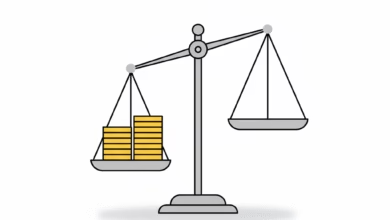
At its core, BNPL creates a powerful illusion of affordability. Mathematically, paying $25 four times is exactly the same as paying $100 once. Psychologically, however, they belong to completely different universes.
When an online shopper sees a full price tag, their brain performs a rapid calculation against their current checking account balance or monthly savings goals. If the price tag is high, it triggers a warning signal.
By slicing that price tag into fourths, the purchase instantly appears accessible to a wider pool of income. It tricks your internal budgeting system into thinking you are saving money, or at least spending less of it. This phenomenon explains why studies consistently show that consumers spend significantly more money per transaction when using BNPL services than when using traditional payment methods. You aren’t just buying the item; you are buying the psychological comfort of feeling like you can easily afford it.
To see this exact mechanism in action, let’s explore how multiple “small, harmless” payments quietly stack up against your real-world monthly budget.
How E-Commerce Platforms Use Dark Patterns to Trigger Impulse Buying
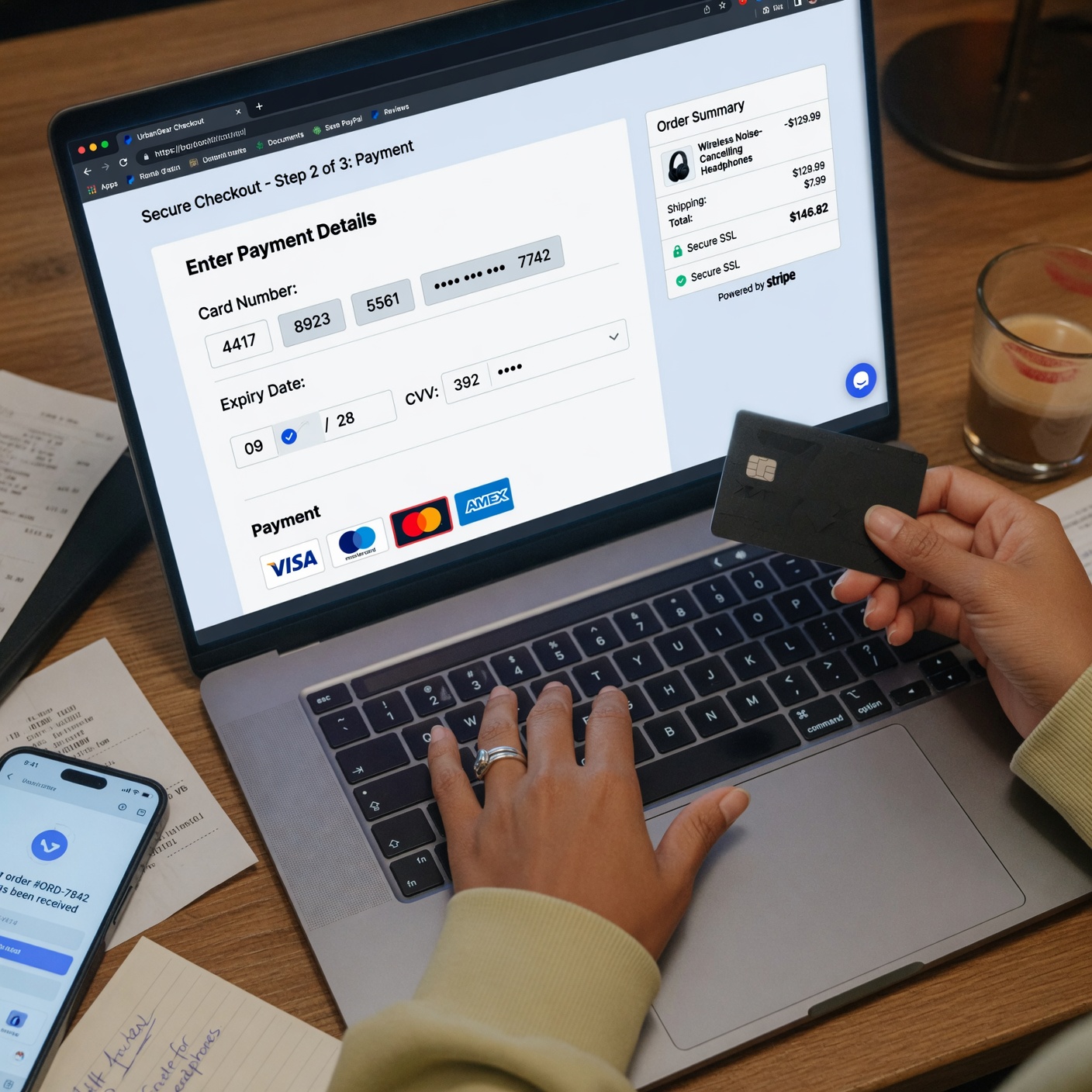
The seamless integration of Buy Now, Pay Later options into online checkouts is not an accident. It is a carefully calibrated user experience designed to maximize conversion rates and average order values. Retailers pay substantial fees to BNPL providers (often higher than standard credit card processing fees) precisely because they know these systems successfully trigger impulse buying.
Many online stores employ what user-experience designers call dark patterns—user interfaces designed to trick users into doing things they might not otherwise do, like spending more money. Examples of these patterns in the context of BNPL include:
-
Pre-Selected Options: Having the BNPL option automatically checked as the default payment method during checkout, forcing the user to manually switch back to a standard debit or credit card.
-
Visual Dominance: Making the installment price significantly larger, bolder, and brighter than the actual full price of the item. The full price is often hidden in small, gray text below the flashy installment number.
-
Urgency and FOMO: Coupling BNPL offers with countdown timers or “low stock” warnings, forcing the consumer to make a split-second decision before present bias can be countered by rational thought.
By minimizing the steps between desire and ownership, e-commerce platforms remove the critical cooling-off period that naturally prevents us from making regretful financial choices.
BNPL vs. Credit Cards: A Psychological Breakdown of Debt Mechanisms
Many consumers view BNPL as a safer alternative to credit cards because most basic BNPL plans do not charge compounding interest if paid on time. However, the psychological mechanics of how both systems lead to overspending are remarkably distinct.
| Feature | Traditional Credit Cards | Buy Now, Pay Later (BNPL) |
| Primary Psychological Trap | The Mirage of the Future: “I’ll pay off the whole balance when my statement arrives next month.” | The Illusion of Scale: “This item only costs a tiny fraction of its actual retail price right now.” |
| Tracking Visuals | A centralized, growing balance visible in a single online banking app or monthly statement. | Fragmented, isolated transactions spread across multiple different apps and custom payment schedules. |
| Interest Risk | High compounding interest rates applied to any revolving balance carried over month-to-month. | No interest for standard short-term plans, but heavy reliance on late fees and immediate account freezes. |
| Perceived Friction | Higher friction due to credit checks, credit limits, and formal card applications. | Zero friction with near-instant approvals directly embedded inside the shopping cart. |
While credit cards encourage you to overspend by giving you a massive, monolithic line of credit, BNPL encourages you to overspend by blinding you to the cumulative total of your smaller transactions.
The Financial Dark Side: What Happens When the Illusion Fades?
While the psychological journey of using BNPL starts with excitement and a dopamine hit, the reality of managing multiple split payments can quickly become stressful.
Because BNPL loans are often decentralized—meaning you might have one plan with Klarna, two with Afterpay, and another with Affirm—it becomes incredibly easy to lose track of your cash flow. This is a phenomenon known as debt stacking. A consumer might easily remember that they owe $30 every two weeks for a pair of shoes. But they forget about the $15 for a cosmetics order, the $40 for a gadget, and the $25 for a clothing item.
When these automated bi-weekly withdrawals hit a checking account simultaneously, they can easily cause overdraft fees or leave the consumer without enough cash to cover essential expenses like groceries, utilities, or rent. Furthermore, failing to make these payments on time shatters the “interest-free” promise, triggering steep late fees and potentially damaging your credit score if the debt is handed over to a collections agency.
Rewiring Your Brain: Behavioral Strategies to Break the BNPL Cycle

If you find yourself constantly relying on Buy Now, Pay Later to fund your lifestyle, you aren’t alone. The system is designed to win. However, by understanding the behavioral science behind these platforms, you can implement practical counter-strategies to regain control of your financial decision-making.
Introduce Strategic Friction
The primary goal of BNPL is to make spending frictionless. To fight back, you need to intentionally inject friction back into your checkout process.
-
Delete the Apps: Remove BNPL applications from your phone and clear your saved account details from your mobile browser. Forcing yourself to manually log in and enter your information creates a natural pause that can break an impulse buying cycle.
-
The 72-Hour Rule: Whenever you are tempted to use a BNPL option, force yourself to close the tab and wait exactly three days. If you still want and can afford the item after 72 hours, return to make the purchase. More often than not, the initial dopamine spike will fade, and you will realize you didn’t actually need the item.
Translate Installments into Hours Worked
To counter the illusion of affordability created by split payments, translate the total cost of the item into the real asset you are trading for it: your time.
Calculate your actual hourly take-home pay (after taxes). If you earn $20 an hour net, a $200 item doesn’t cost “four easy payments of $50″—it costs 10 hours of your life. Asking yourself, “Is this jacket worth two full days of standing at my job or sitting at my desk?” is an incredibly powerful way to restore emotional perspective to your spending.
Practice Holistic Budgeting
Instead of evaluating purchases in isolation, practice looking at your financial picture as a whole. Before clicking checkout, log into your primary bank account and look at your actual fixed expenses for the upcoming month. Incorporating a dedicated “fun money” category into your budget ensures that when you do treat yourself, you are paying with real, unencumbered cash—free from the lingering ghost of future bi-weekly obligations.