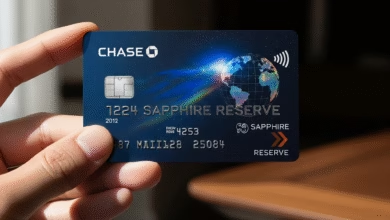
Chase Sapphire Preferred vs Reserve: which is better?
Which Chase card offers the best travel rewards and perks?
The debate between the Chase Sapphire Preferred® Card and the Chase Sapphire Reserve® is a rite of passage for anyone getting serious about travel rewards. These two cards are the crown jewels of the Chase Ultimate Rewards ecosystem, and for good reason. They offer some of the most flexible, valuable points in the industry, backed by a robust network of airline and hotel partners.
However, choosing between them isn’t as simple as “the more expensive one is better.” For many travelers, the premium price tag of the Reserve is a masterclass in luxury, while for others, the Preferred is the most efficient value-builder on the market. In this 3,000+ word deep dive, we are going to break down every fee, every point, and every perk to help you decide which piece of metal belongs in your wallet.
The Fundamental Difference: Mid-Tier Value vs. Luxury Powerhouse

At a glance, these cards look similar, but they serve two very different lifestyles.
The Chase Sapphire Preferred is often called the “gold standard” of entry-level travel cards. With a manageable $95 annual fee, it provides high-value rewards without requiring you to change your spending habits.
The Chase Sapphire Reserve, on the other hand, is a premium “lifestyle” card. It carries a $550 annual fee, but it offsets that with high-end perks like airport lounge access, a massive travel credit, and elite insurance coverage.
To determine which is “better,” we have to look past the marketing and into the math.
Breaking Down the Annual Fees: Is the $550 Price Tag Justified?
The biggest hurdle for most people is the $550 annual fee for the Reserve. Compared to the Preferred’s $95, it feels like a massive leap. But here is where the “effective annual fee” comes into play.
The Reserve’s $300 Travel Credit
The Chase Sapphire Reserve comes with a $300 annual travel credit. This is incredibly easy to use. Unlike other premium cards that force you to jump through hoops (like specific airline incidentals), Chase applies this credit automatically to almost anything that counts as travel: Uber rides, tolls, parking, flights, hotels, and even trains.
-
Reserve Math: $550 Fee – $300 Credit = $250 Effective Annual Fee.
-
Preferred Math: $95 Fee = $95 Effective Annual Fee.
While the Reserve is still more expensive ($250 vs $95), the gap is much smaller than it first appears. To bridge the remaining $155 difference, you need to look at the points multipliers and the lifestyle perks.
Point Multiplication: Which Card Earns Faster for Your Lifestyle?
Both cards earn Chase Ultimate Rewards (UR) points, but they do so at different speeds. If you spend heavily on travel and dining, the Reserve can quickly pay for itself through sheer point accumulation.
Travel Rewards
-
Preferred: 2x points on travel (5x if booked through Chase Travel℠).
-
Reserve: 3x points on travel (10x on hotels and car rentals booked through Chase; 5x on flights).
Dining and Groceries
-
Preferred: 3x on dining, online groceries, and select streaming services.
-
Reserve: 3x on dining (10x on Chase Dining).
If you are a frequent traveler who spends $10,000 a year on flights and hotels, the Reserve will net you 30,000 points compared to the Preferred’s 20,000. Depending on how you redeem those points, that 10,000-point difference can easily be worth $150 or more.
Redemption Value: Why 1.25 Cents vs. 1.5 Cents Matters

This is where the Reserve shows its true power. When you redeem your points through the Chase Travel portal:
-
Preferred points are worth 1.25 cents each.
-
Reserve points are worth 1.5 cents each.
The “Portal Power” Example
Imagine you have 100,000 Chase points.
-
With the Preferred, those points are worth $1,250 toward a flight.
-
With the Reserve, those points are worth $1,500 toward that same flight.
That $250 difference in redemption value alone covers the gap in effective annual fees. If you plan on accumulating and spending large amounts of points, the Reserve is the superior vehicle for getting the most “bang for your buck.”
Airport Lounge Access: The Sapphire Reserve’s Secret Weapon
For the frequent traveler, nothing changes the airport experience like lounge access. The Chase Sapphire Reserve comes with a Priority Pass Select membership.
This gives you (and two guests) access to over 1,300 airport lounges worldwide. In these lounges, you get free food, drinks (including alcohol), Wi-Fi, and a quiet place to work. If you typically spend $30 on an airport meal and a drink every time you fly, and you fly five times a year with a guest, that lounge access is worth $300 annually.
The Chase Sapphire Preferred has no lounge access whatsoever. If you value comfort and the “VIP” experience, the Reserve wins by a landslide here.
Global Entry, TSA PreCheck, or NEXUS Credits
The Reserve offers a statement credit of up to $100 every four years to cover the application fee for Global Entry, TSA PreCheck, or NEXUS.
If you’ve ever stood in a two-hour customs line after a 10-hour international flight, you know that Global Entry is worth its weight in gold. Since this credit is available every four years, it adds an average of $25 in value per year to the Reserve. Again, the Preferred does not offer this perk.
Travel Protections: The Insurance You Hope You Never Need
Both cards are famous for their travel insurance, but the Reserve offers “Elite” level protection that can save you thousands in a crisis.
Primary Auto Rental Collision Damage Waiver
Both cards offer Primary rental car insurance. This is huge. Most credit cards offer secondary insurance, meaning you have to file with your personal insurance company first. With Chase Sapphire, you can decline the rental agency’s expensive insurance, and if you get into an accident, Chase pays the bill directly without your personal insurance rates going up.
Trip Delay Reimbursement
-
Preferred: If your trip is delayed by 12 hours or requires an overnight stay, you are covered for up to $500 in expenses (hotels, meals).
-
Reserve: That window drops to 6 hours.
If you are stuck in a weather delay at O’Hare, waiting 6 hours is much more common than 12. The Reserve’s lower threshold makes it much easier to actually use the insurance.
Transfer Partners: The Great Equalizer

It is important to note that both cards have access to the exact same 1:1 Transfer Partners. This is the most “advanced” way to use Chase points. You can transfer your points to:
-
Airlines: United, Southwest, British Airways, Singapore Airlines, Virgin Atlantic, and more.
-
Hotels: World of Hyatt, Marriott, and IHG.
World of Hyatt is widely considered the best transfer partner in the business. It is not uncommon to find Hyatt stays where your points are worth 2 to 3 cents each. Because both cards have this ability, the Preferred remains a very strong choice for people who don’t care about lounge access but want to earn Hyatt points for cheap.
The “Chase Trifecta”: How to Supercharge Your Wealth Building
To truly stop living “paycheck to paycheck” with your points, you shouldn’t just have one card. You should build the Chase Trifecta. This usually consists of:
-
Chase Sapphire (Preferred or Reserve)
-
Chase Freedom Flex℠
-
Chase Freedom Unlimited®
The Freedom cards have no annual fee but earn 5% on rotating categories or 1.5% on all purchases. However, on their own, Freedom points can only be redeemed for cash back (1 cent per point).
By having a Sapphire card, you can move your Freedom points to your Sapphire account. Suddenly, those 1-cent points become 1.25 or 1.5 cents (or more via transfer partners). This is the “secret sauce” of the US credit card game.
Determining Your Break-Even Point: A Practical Exercise
If you are still undecided, ask yourself these three questions:
-
How much do I spend on travel? If it’s more than $300 (which is a single cheap flight or two hotel nights), the Reserve’s $300 credit is basically cash in your pocket.
-
How many airports do I visit? If you visit more than three airports a year, Priority Pass lounge access is a game-changer for your mental health and your wallet (saving on airport food).
-
Do I prefer simplicity or optimization? The Preferred is a “set it and forget it” card. The Reserve requires you to track your credits and use the portal to maximize the 1.5x value.
Which One Should You Apply For?

Choose the Chase Sapphire Preferred if:
-
You want a low-risk, high-reward entry into the world of travel points.
-
You primarily use transfer partners (like Hyatt) and don’t care about the 1.5x portal value.
-
You don’t travel enough to justify a $550 upfront cost.
-
You want a card with a great sign-up bonus that you can keep for decades without worrying about the fee.
Choose the Chase Sapphire Reserve if:
-
You travel at least 3-4 times per year.
-
You value airport lounge access and Global Entry.
-
You want the absolute best travel insurance and protections available.
-
You plan on redeeming a large volume of points through the Chase portal for the 50% bonus.
The Power of Choice in Your Financial Journey
Whether you choose the Preferred or the Reserve, you are making a smart financial move. Both cards allow you to turn your everyday spending—groceries, gas, dining—into luxury travel experiences that would otherwise cost thousands of dollars.
In the world of finance, “taking control” means making your money work for you. Using a Sapphire card to fund your vacations is a prime example of building wealth through smart consumption.