A complete guide on how to study cryptocurrencies from beginner to advanced
Learn how to dive headfirst into the world of digital currencies with this complete guide
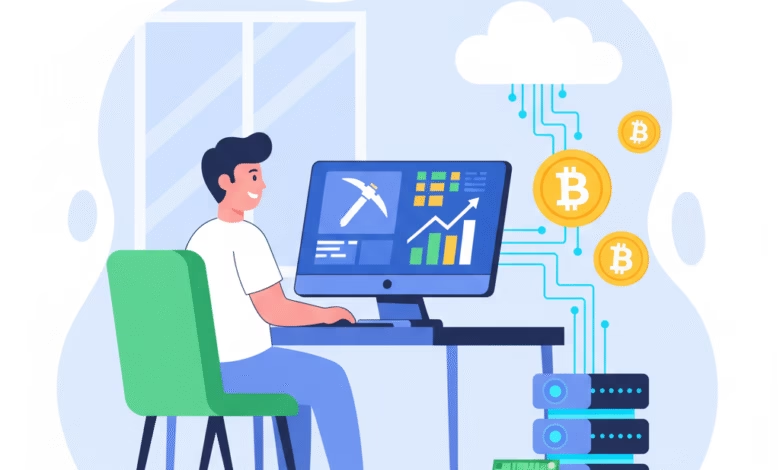
In 2009, a pseudonymous programmer named Satoshi Nakamoto released a nine-page document that changed the world of finance forever. Today, cryptocurrency is no longer just a niche internet hobby for computer geeks. It is an asset class held by Wall Street institutions, major corporations, and millions of everyday Americans.
However, stepping into the world of crypto feels like learning a new language while trying to drink from a firehose. The terminology alone—blockchains, yield farming, sharding, non-fungible tokens—is enough to make a reasonable person close their browser tab.
If you are reading this, you’ve likely realized that ignoring this technology is no longer an option. Whether you want to invest for retirement, trade for income, or simply understand the future of the internet, you need a plan.
This guide is that plan. We have broken down the learning process into distinct “semesters,” taking you from a complete novice to a sophisticated market participant. Put away the hype and get ready to study.
Phase 1: The Foundations (The “Kindergarten” Phase)

Before you buy a single Satoshi, you must understand what you are buying. Most people skip this step and go straight to “Which coin will make me rich?” This is why most people lose money.
Understanding Money and The Ledger
To understand Bitcoin, you must first understand the flaws in our current system.
-
Fiat Currency: Understand how the Federal Reserve operates. Learn about inflation and why the purchasing power of the US Dollar decreases over time.
-
The Problem: Traditional money relies on trusted third parties (banks). If the bank freezes your account, you have no access.
-
The Solution: Cryptocurrency is “trustless.” It relies on math, not managers.
Demystifying the Blockchain
You don’t need to be a coder, but you need the basics.
-
The Analogy: Think of a blockchain as a shared Google Doc that everyone can read, but no one can delete. Once a transaction is written, it is permanent (immutable).
-
Decentralization: There is no central server. The database lives on thousands of computers (nodes) around the world simultaneously.
Bitcoin vs. Ethereum: The Big Two
If you only learn two things, learn these.
-
Bitcoin (BTC): Digital Gold. It is a store of value. Its supply is capped at 21 million. It is designed to be slow, secure, and scarce.
-
Ethereum (ETH): The World Computer. It introduced “Smart Contracts.” If Bitcoin is a calculator, Ethereum is a smartphone. You can build apps (DApps) on top of it.
Action Item: Read the Bitcoin Whitepaper. It is only 9 pages long and written in surprisingly plain English. It is the Declaration of Independence of the crypto world.
Phase 2: Security and Mechanics (Learning to Drive)
Now that you know the theory, it is time for the practical mechanics. In crypto, you are your own bank. That means there is no customer support hotline if you make a mistake.
The Wallet Hierarchy: Hot vs. Cold Storage
You must learn how to store your assets.
-
Custodial Wallets (The Bank): This is when you leave your crypto on an exchange like Coinbase or Kraken. It is convenient, but risky. If the exchange goes bankrupt (like FTX), your money is gone.
-
Non-Custodial Wallets (The Cash): You hold the keys.
-
Hot Wallets: Software on your phone/browser (e.g., MetaMask). Good for spending, bad for life savings.
-
Cold Wallets: Hardware devices (e.g., Ledger, Trezor). This is the gold standard for security.
-
The “Seed Phrase” Rule
This is the most critical lesson in your entire education. When you create a wallet, you get a 12-24 word phrase.
-
The Rule: If you lose this phrase, you lose your money. If someone else sees this phrase, they steal your money. Never store it digitally (no screenshots, no Google Drive). Write it on paper or steel.
Executing Your First Transaction
Don’t bet the farm yet.
-
Buy $20 worth of crypto on a reputable US exchange.
-
Set up a software wallet.
-
Send the $20 from the exchange to your wallet.
-
Send it back.
-
Watch the “Block Explorer” (like Etherscan) to see your transaction confirm in real-time.
Action Item: Purchase a hardware wallet if you plan to invest more than $1,000. It is the cheapest insurance policy you will ever buy.
Phase 3: The Ecosystem (High School)
Once you are comfortable with the “Big Two” and wallet security, it’s time to explore the rest of the jungle. This is where high risk meets high reward.
Altcoins and Market Cycles
Bitcoin moves in 4-year cycles focused around the “Halving” (when the supply of new Bitcoin is cut in half).
-
Altcoins: “Alternative Coins.” This includes everything that isn’t Bitcoin. They are generally more volatile.
-
The Flow: Money usually flows into Bitcoin first, then Ethereum, then large-cap altcoins, and finally into risky “memecoins.” Understanding where we are in this cycle is crucial.
DeFi: Decentralized Finance
DeFi recreates traditional banking services without the bank.
-
Lending/Borrowing: You can lend your stablecoins (crypto pegged to the Dollar) to others and earn interest (yield).
-
DEXs (Decentralized Exchanges): Platforms like Uniswap allow you to trade peer-to-peer without an account or identity verification.
Stablecoins: The Bridge
Learn the difference between:
-
Fiat-Backed: USDT (Tether) and USDC (Circle). Backed by real dollars in a bank account.
-
Algorithmic: Backed by math. These are riskier (e.g., the collapse of Terra/Luna).
Action Item: Go to a site like CoinGecko or CoinMarketCap. Look at the Top 50 coins. Read the one-paragraph summary for each. Don’t buy them yet—just understand what different problems they are trying to solve.
Phase 4: Fundamental Analysis (College – The Investor Mindset)
This is the differentiator between a gambler and an investor. How do you value a digital asset that produces no cash flow?
Mastering Tokenomics
“Tokenomics” is the economics of the token. You must look at the supply.
-
Market Cap vs. Unit Price: This is the rookie mistake. A coin costing $0.0001 is not “cheaper” than Bitcoin at $60,000 if the cheap coin has a supply of 500 trillion. Always look at Market Cap.
-
Circulating vs. Total Supply: If a project has released only 10% of its tokens, what happens when the other 90% are released? Inflation crashes the price.
-
Vesting Schedules: When do the early investors (VCs) get their tokens? You don’t want to buy right before they unlock and dump on the market.
Vetting the Team and Whitepaper
-
The Team: Are they anonymous? Did they work at Google or Apple, or do they have no history?
-
The Utility: Does this token actually need to exist? Or is it just a solution looking for a problem?
-
The Community: Go to their Discord or Twitter. Are they discussing technology and roadmaps, or just posting rocket emojis and asking “When Lambo?” (A bad sign).
Action Item: Pick one project in the Top 20. Find its “Whitepaper” on its website. Try to read the abstract and the “Tokenomics” section.
Phase 5: Technical Analysis (Optional but Recommended)
You don’t need to be a day trader, but you should know how to read a chart so you don’t buy at the absolute top.
Candlesticks and Trends
Learn to read a “Candlestick Chart.” It tells you the open, close, high, and low price for a specific time period.
-
Support and Resistance: These are psychological price levels. “Support” is a floor where buyers step in. “Resistance” is a ceiling where sellers take profit.
-
Moving Averages: The 200-week Moving Average is historically a great indicator for the long-term trend of Bitcoin.
Risk Management
This is more important than reading charts.
-
Position Sizing: Never put more than 1-5% of your portfolio into a high-risk speculative play.
-
Stop Losses: Know the price at which you will admit you were wrong and sell to preserve capital.
Action Item: Create a free account on TradingView. Pull up the BTC/USD chart. Try to identify the “All Time High” and the recent “Lows.”
Phase 6: Advanced Concepts (Master’s Degree)

Now we enter the cutting edge. This is where the industry is moving right now.
Layer 2 Solutions and Scaling
Ethereum is slow and expensive. “Layer 2” networks (like Arbitrum, Optimism, and Base) sit on top of Ethereum to make it fast and cheap. Understanding this “modular” architecture is key to the future of crypto.
On-Chain Analysis
The blockchain is transparent. You can see what the “Whales” (people with massive amounts of money) are doing.
-
Exchange Outflows: When huge amounts of Bitcoin leave exchanges (moving to cold storage), it is usually bullish (people are holding).
-
Exchange Inflows: When Bitcoin moves to exchanges, it is usually bearish (people are preparing to sell).
Governance and DAOs
Many modern tokens grant you voting rights. A DAO (Decentralized Autonomous Organization) is a company run by code and voted on by token holders.
Essential Toolkit: What the Pros Use
To study effectively, you need the right tools. Bookmark these.
-
News & Sentiment: CoinDesk, The Block, CryptoPanic (an aggregator).
-
Price & Data: CoinGecko, CoinMarketCap, TradingView.
-
Research & Deep Dives: Messari (great reports), Dune Analytics (visualizing on-chain data).
-
Portfolio Tracking: CoinStats or Delta App.
The Learning Never Stops
Studying cryptocurrency is not like studying history. History doesn’t change every week. Crypto does. The “hot new thing” in January might be obsolete by December.
The goal of this roadmap is not to make you an overnight millionaire. The goal is to build a mental framework that allows you to filter the signal from the noise.
Start small. Be skeptical. verify everything. And remember the golden rule of crypto investing: Only invest what you can afford to lose. The volatility is the price you pay for the performance.
Welcome to the future of finance. Class is in session.
Frequently Asked Questions (FAQ)
Q: Do I need to be good at math to understand crypto?
A: No. While the underlying technology (cryptography) is math-heavy, using and investing in crypto requires logic and research skills, not advanced calculus.
Q: How much time does it take to learn?
A: You can understand the basics in 10–20 hours of focused reading. Mastering the market cycles and advanced DeFi concepts can take years of experience.
Q: Is it too late to start studying?
A: Absolutely not. While Bitcoin is no longer $1, the industry is still in its infancy. Major financial institutions (like BlackRock) are just now entering the space. We are arguably still in the “early adoption” phase compared to the internet in the late 90s.
Q: Where can I take formal courses?
A: If you prefer structured learning, reliable platforms like Coursera and Udemy offer blockchain courses from universities like Princeton and MIT. Be very careful of “Gurus” selling expensive courses on YouTube/Instagram. Most of that information is available for free.