Essential books for beginner investors
Learn from the teachings of renowned investors and authors who have left their mark on the financial market

Embarking on your financial journey can feel like stepping into a foreign country without a map. The stock market has its own language, thousands of moving parts, and a constant stream of noise that can easily overwhelm anyone trying to make sense of it. Fortunately, you do not have to figure out the rules of wealth creation on your own. Some of the most brilliant minds in financial history have left behind detailed blueprints of their strategies, successes, and failures.
Reading is the ultimate shortcut in investing. By spending a few hours with a book, you can absorb decades of trial, error, and multi-million-dollar insights. Whether you want to master index funds, understand the psychology of greed and fear, or learn how to analyze an individual stock’s balance sheet, the right literature is your greatest asset.
This comprehensive guide breaks down the absolute best investing books for beginners, categorized by strategy, so you can build a rock-solid foundation for your financial future.
Why Building a Personal Finance Library is Your Highest-Return Investment

Before looking at specific stock tickers or opening a brokerage account, the most critical asset you must cultivate is your own mind. In the world of finance, knowledge acts as a shield against costly mistakes. Without a solid strategic foundation, beginner investors often fall prey to market hype, panic-selling during temporary downturns, or chasing speculative trends that lead to heavy losses.
When you invest in high-quality financial books, you are acquiring:
-
Risk Mitigation: Understanding how market cycles work prevents you from buying at the absolute peak and selling at the absolute bottom.
-
Behavioral Control: The hardest part of investing is not math; it is managing your emotions when your portfolio value fluctuates.
-
Decades of Experience in Hours: You get to study the exact blueprints used by billionaires like Warren Buffett, Benjamin Graham, and John Bogle.
-
Cost Efficiency: A single bad investment can easily cost you thousands of dollars. A $15 book can save you from making that mistake in the first place.
Classic Value Investing Books to Master Stock Market Fundamentals
Value investing is the art of buying assets for less than they are actually worth. It is a conservative, highly disciplined approach that has minted some of the wealthiest individuals on the planet. If you want to understand how to value a business and look at stocks as actual ownership stakes rather than digital lottery tickets, these are the books you must read.
1. The Intelligent Investor by Benjamin Graham
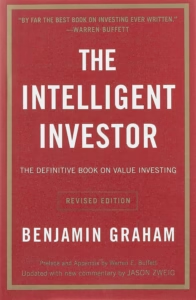
Widely considered the definitive bible of the stock market, this masterpiece is the cornerstone of value investing. Benjamin Graham, who was Warren Buffett’s mentor and professor, first published this book in 1949, yet its core principles remain incredibly accurate today.
-
Key Concept: The distinction between “investment” and “speculation.” Graham teaches that an investment is operations that promise safety of principal and an adequate return; anything else is speculative.
-
The Myth of “Mr. Market”: Graham introduces the famous allegory of Mr. Market—an emotional business partner who offers to buy or sell shares every single day at wild price fluctuations. The lesson is to exploit Mr. Market’s mood swings, not to be influenced by them.
-
Margin of Safety: This is the most crucial concept in the book. Graham argues that you should only buy a stock when its market price is significantly below its intrinsic value, giving yourself a buffer for error or unexpected economic downturns.
2. One Up on Wall Street by Peter Lynch
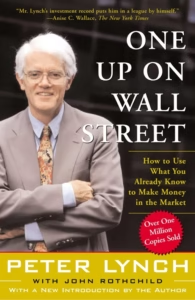
If The Intelligent Investor feels a bit too academic, Peter Lynch’s classic is the perfect, highly accessible antidote. Lynch managed the Fidelity Magellan Fund from 1977 to 1990, averaging an astonishing 29.2% annual return.
-
Key Concept: “Invest in what you know.” Lynch firmly believes that average individual investors have a massive advantage over professional Wall Street analysts simply by observing their everyday surroundings.
-
Local Observations: If you notice a local restaurant chain is always packed, a new software tool is becoming indispensable at your office, or a specific brand of clothing is selling out everywhere, you have found a potential investment candidate long before Wall Street notices it.
-
The Art of Categorizing Stocks: Lynch teaches readers how to classify companies into six distinct categories (such as “Slow Growers,” “Stalwarts,” and “Fast Growers”) and explains exactly how to approach each type.
The Best Index Fund Books for Automated Passive Income Growth
Not everyone has the time, desire, or analytical skills to research individual companies, read quarterly balance sheets, and track corporate earnings. Luckily, you do not have to. Passive investing allows you to capture the overall growth of the stock market with minimal effort and virtually zero maintenance. These books explain how to build a highly profitable portfolio using index funds.
3. The Little Book of Common Sense Investing by John C. Bogle
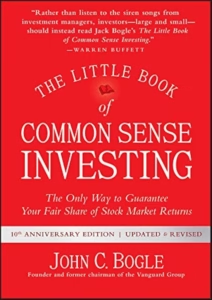
John C. Bogle is the legendary founder of Vanguard and the creator of the very first retail index fund. This book is a straightforward, passionately argued manifesto explaining why trying to beat the market is a fool’s errand for the vast majority of people.
-
Key Concept: The relentless math of compounding fees. Bogle demonstrates how active mutual funds charge high management fees that quietly eat away at your long-term returns.
-
Owning the Entire Market: Instead of trying to find the needle in the haystack (the next superstar stock), Bogle suggests simply buying the entire haystack by purchasing a low-cost, broad-market index fund that tracks the S&P 500 or the total stock market.
-
Simplicity Wins: By minimizing transaction costs, taxes, and management fees, and holding your investments for decades, you are virtually guaranteed to outperform the majority of professional money managers.
4. The Simple Path to Wealth by JL Collins
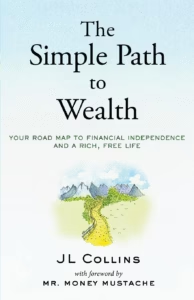
What started as a series of letters from a father to his daughter about money eventually turned into one of the most celebrated modern personal finance books. Collins strips away all the unnecessary complexity of the financial industry to deliver a incredibly clean, highly actionable investment strategy.
-
Key Concept: Achieving “F-You Money.” This is the amount of accumulated wealth that grants you complete freedom to walk away from a bad job, take career risks, and live life entirely on your own terms.
-
The Single-Fund Portfolio: Collins advocates for an incredibly simple approach: putting your investment capital into a single, total stock market index fund (specifically highlighting VTSAX) and letting the natural growth of American business do the heavy lifting over time.
-
Market Volatility is Normal: The book provides deep comfort for beginners by explaining that market crashes are not a sign that the system is broken; they are a perfectly natural, expected part of the economic cycle.
Understanding the Psychology of Money and Wealth Preservation
You can have the most sophisticated mathematical model in the world, but if you panic and sell everything when the market drops 20%, your strategy is worthless. True investing success is determined far more by your behavior, emotional discipline, and relationship with money than by your intelligence or analytical skills.
| Book Title | Author | Core Focus | Target Audience |
| The Psychology of Money | Morgan Housel | Behavioral finance, greed, and envy | Everyone looking to build a healthy relationship with wealth |
| Thinking, Fast and Slow | Daniel Kahneman | Cognitive biases and decision-making | Investors wanting to avoid mental traps and emotional trading |
| Rich Dad Poor Dad | Robert Kiyosaki | Assets vs. Liabilities, mindset shift | Beginners needing a fundamental reset on how money works |
5. The Psychology of Money by Morgan Housel
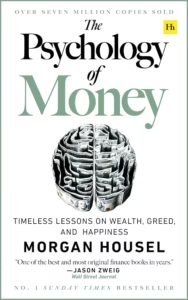
Through 19 short, beautifully written stories, Morgan Housel explores the strange ways people think about wealth. He argues that doing well with money is not necessarily about what you know; it is about how you behave.
-
Key Concept: “Enough.” One of the hardest financial skills to master is stopping the goalposts from moving. Housel warns against risking what you have and need for what you don’t have and don’t need.
-
The Difference Between Being Rich and Being Wealthy: Being rich is about your current income and showing off material possessions (fancy cars, big houses). Wealth, on the other hand, is invisible; it is the saved money, unsold investments, and assets that give you control over your time.
-
The Power of Staying Put: Housel highlights that the single most important factor in compounding is not high returns, but uninterrupted time. Simply surviving market cycles without interrupting the process is the ultimate superpower.
6. The Millionaire Next Door by Thomas J. Stanley and William D. Danko
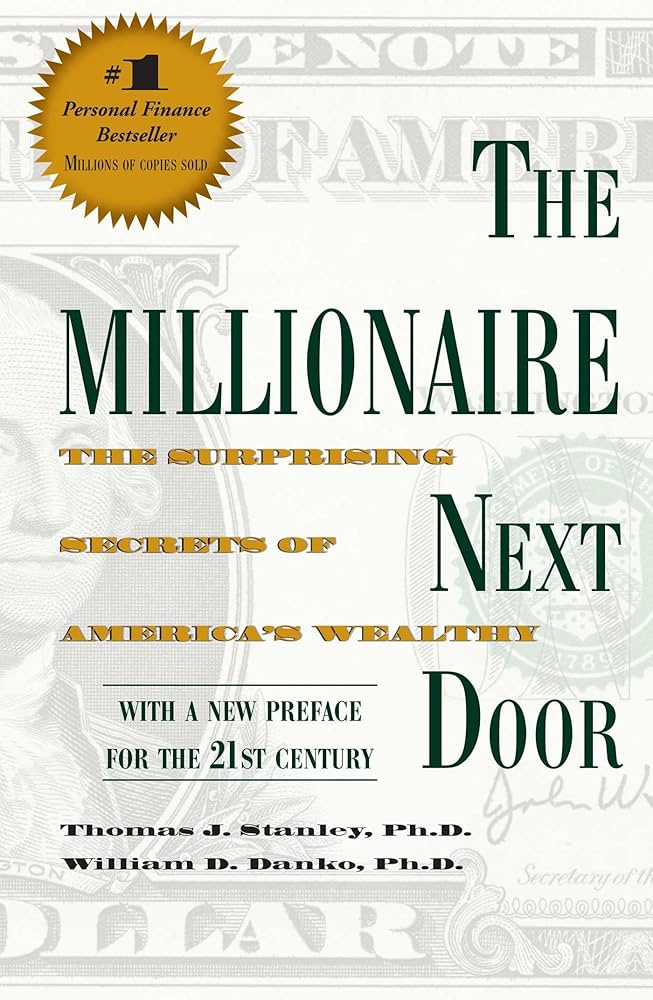
This eye-opening book is the result of decades of research studying actual millionaires. The authors discovered a stark contrast between what popular culture portrays as a millionaire and the reality of who actually holds wealth.
-
Key Concept: High consumption vs. high net worth. Most self-made millionaires do not drive brand-new sports cars, wear designer clothes, or live in mansions. Instead, they live in unassuming neighborhoods, drive used cars, and practice intense frugality.
-
Under Accumulators of Wealth (UAWs) vs. Prodigious Accumulators of Wealth (PAWs): The book teaches you how to identify where you stand. Many people with high incomes have close to zero net worth because they spend everything they make, while moderate earners build massive nest eggs through consistent saving and investing.
How to Apply What You Read: Turning Financial Literacy into Real Wealth
Reading these books is only the first step. The real magic happens when you translate this theoretical knowledge into concrete action. Many beginners make the mistake of reading book after book without ever opening an investment account or changing their spending habits.
To ensure you get the absolute most out of your reading, follow this structured implementation roadmap:
Step 1: Eliminate High-Interest Debt First
Before allocating any money to the stock market, tackle any high-interest liabilities, such as credit card debt. No reliable investment strategy consistently yields the 18% to 25% returns that credit card companies charge you in interest. Paying off high-interest debt is equivalent to a guaranteed, tax-free return on your money.
Step 2: Build an Emergency Fund
An emergency fund is the ultimate buffer that protects your investments. Aim to save three to six months’ worth of living expenses in a high-yield savings account. Having this cash cushion ensures that if you lose your job or face an unexpected medical bill, you will not be forced to liquidate your stock portfolio during a market downturn to cover your expenses.
Step 3: Keep Your Investing Strategy Extremely Simple
When you are ready to start, do not overcomplicate your portfolio. You do not need to manage thirty different stocks, crypto assets, and commodities. Start with a simple, low-cost, broad-market index fund that covers the entire market. As your confidence, capital, and knowledge base grow, you can slowly allocate a small percentage of your portfolio to individual stocks if you wish to actively research companies.
Step 4: Automate Your Contributions
The most successful investors remove human emotion from the equation entirely. Set up automatic transfers from your paycheck directly into your investment account on a monthly or bi-weekly basis. This strategy, known as dollar-cost averaging, ensures that you automatically buy more shares when prices are low and fewer shares when prices are high.
Start Reading, Start Saving, and Let Time Do the Rest
The road to financial independence is not a sprint; it is a long, disciplined marathon. The books outlined in this guide represent the collective wisdom of centuries of economic history. They teach you how to think about value, how to master your own psychological impulses, and how to harness the incredible power of compounding interest.
Pick just one book from this list to start with. Read it carefully, take notes, and think about how the concepts apply to your personal financial situation. Once you understand the fundamental rules of the game, you can invest with absolute confidence, knowing that your decisions are backed by time-tested, proven strategies. Your future self will thank you for the time you spend reading today.